

 Follow
 Rekomendasi
Recommendations for Funny and Educational Cartoon Movies, Perfect for Family Weekend Viewing
Many believe that cartoons are only for children, but in reality, these animations often carry deep messages that can touch the hearts of all ages.

Kapanlagi.com - The world of demographics is once again stirred by the emergence of a new term for babies born starting in 2026. Babies born in 2026 are now known by two interesting terms, namely Generation Sigma and Generation Beta.
This phenomenon raises questions about the unique characteristics that will be attached to this future generation. The difference between these two terms has become a hot topic of discussion across various media platforms.
This article will explore what Generation Sigma and Generation Beta are, and how they will shape the future amidst the onslaught of technology. For more details, check here about the term for the generation born in 2026.
Read other articles on the same topic at Liputan6.com.

The Origin of the Term Generation and Its Differences (credit: unsplash)
Demographic grouping based on birth year ranges serves as the basis for naming each generation. This helps to understand social changes and the unique characteristics of each group.
Terms like Baby Boomers, X, Y, Z, and Alpha are rooted in demographic groupings popularized by researchers, sociologists, and survey institutions like the Pew Research Center. These names are assigned to understand social changes, historical events, and technology adoption that shape their character.
Each generation has its own distinct traits, influenced by the environment and the times during which they grew up. From the resilience of Pre-Boomers to the independence of Gen X, each era produces individuals with unique perspectives.
- Pre-Boomer / The Builders (Before 1946): A resilient generation that went through tough times like the Great Depression and World War II, highly valuing values and commitment.
- Baby Boomers (1946-1964): Known for being competitive, achievement-oriented, and career-focused.
- Generation X (1965-1979/1980): Tends to be independent, prioritizes work-life balance, resourceful, and adaptive.
- Generation Y / Millennials (1980/1981-1994/1996): Lives in a time of technological transition, ambitious, tech-savvy, but prone to stress.
- Generation Z (1995/1997-2009/2012): Grows up in a fully digital environment and is tech-literate.
- Generation Alpha (2010/2013-2024): The first generation born entirely in the 21st century, very close to touchscreen technology and predicted to be the most educated.
- Generation Beta ( 2025 to 2039): A generation that begins to recognize AI and IoT (Internet of Things) technology used in everyday life.

Baby Born in 2026: Between Sigma and Beta Generations (credit: unsplash)
Babies born starting in 2026 are currently referred to by two different terms, namely Generation Sigma and Generation Beta. These two designations have different backgrounds and contexts of use in society.
Generation Sigma is a popular term that has recently been increasingly mentioned in social media and public discussions. This term refers to the generation that is expected to start being born in 2026, although it has not yet become an official classification like Generation Z or Alpha.
On the other hand, demographically, children born from 2025 or 2026 until 2039 are more commonly known as Generation Beta or Gen Beta. This term was created by Australian demographer Mark McCrindle and is a more official classification.
The term Sigma has a rich and varied meaning, depending on the context of its use. From its etymological roots to its adaptations in popular culture, Sigma has evolved into a certain symbol.
The origin of the word Sigma comes from the 18th letter of the Greek alphabet, written with the symbol Σ (uppercase) and σ (lowercase). In mathematics, the sigma notation (Σ) introduced by Leonhard Euler in 1755 means summation or addition.
In a social context, especially in social media and masculine subcultures, Sigma is often associated with Male or Sigma Male. This personality type is independent, introverted, and less concerned with social hierarchy, choosing its own path.
- Characteristics of Sigma Male: Quiet yet influential, emotionally independent, good listener, less open with others, hard-working, greatly enjoys solitude, finds it difficult to ask for help, and easily adaptable.
The term Sigma Male itself was created by right-wing activist and author Theodore Robert Beale (Vox Day) in January 2010.

Sigma in Gen Alpha Slang (credit: unsplash)
In addition to its formal and sociological meanings, Sigma has also permeated slang, especially among Generation Alpha. The term takes on a more relaxed and contemporary meaning.
Among Gen Alpha, Sigma is used as slang meaning the coolest or the best among others. This usage shows how the younger generation adapts and gives new meanings to words.
Social media platform users tend to use this term to describe photos or videos that showcase independence, success, or a disregard for others' opinions.
Meanwhile, the term Sigma generation is described as children growing up amidst rapid world changes. They will be familiar with advanced technology from birth, forming a flexible mindset.
This is why babies born in 2026 are referred to as the Sigma Generation, as they are born and raised when AI has already become a normal part of daily life. This is different from previous generations that encountered technology gradually.
Sigma children will not view technology such as AI tutors, digital assistants, or data-based health monitoring systems as something advanced. This condition is expected to give them high adaptability, more flexible thinking, and sensitivity to change.

Predictions of the Unique Characteristics of Generation Sigma (credit: unsplash)
Based on the environment in which they grow up, Generation Sigma is predicted to have a set of characteristics that distinguish them from previous generations. This uniqueness will be heavily influenced by technology and global issues.
From birth, Generation Sigma is predicted to be familiar with advanced technologies such as artificial intelligence (AI), automation, and an increasingly integrated digital world. They will be highly adaptive to technology from an early age.
This generation will also grow up amidst the climate crisis, extreme weather changes, and global awareness of sustainability. Therefore, they are predicted to have a high sensitivity to environmental issues.
While Generation Sigma is a popular term, demographically, babies born from 2026 to 2039 are more accurately referred to as Generation Beta. They are the first generation to fully grow up in the era of AI technology and immersive digital experiences.
Generation Beta is described as the first generation to fully grow up in the era of AI technology and immersive digital experiences. They will experience technology integration that is inseparable from every aspect of life.
This era will be marked by personal AI, algorithm-based adaptive education, and increasingly massive human-machine interactions. Therefore, technology will no longer be a tool but an integral part of their existence.
1. What is Generation Sigma?
Generation Sigma is a popular term used to refer to babies born starting in 2026, predicted to grow up familiar with advanced technologies such as AI and to have high adaptability skills.
2. When are Generation Sigma and Generation Beta born?
Generation Sigma (popular term) is estimated to be born starting in 2026, while Generation Beta (official demographic term) is estimated to be born from 2025 or 2026 until 2039.
3. What is the difference between Generation Sigma and Generation Beta?
Generation Sigma is a popular term that highlights technological adaptation and unique characteristics, while Generation Beta is an official demographic classification by Mark McCrindle for the generation that fully grows up in an AI and immersive digital era.
4. What does the term Sigma mean in a social context?
In a social context, Sigma often refers to Sigma Male, which is a type of male personality that is independent, introverted, indifferent to social hierarchy, and values personal freedom.
Stay updated with the latest celebrity news only at Kapanlagi.com. If not now, when?
(kpl/nlw)
Cobain For You Page (FYP) Yang kamu suka ada di sini,
lihat isinya
Many believe that cartoons are only for children, but in reality, these animations often carry deep messages that can touch the hearts of all ages.

Need recommendations for exciting fantasy romance anime that will make you feel all the emotions? We have summarized the best options that offer unique and emotional storylines, ready to entertain you and take you into a world full of love and adventure!

The skincare trend in 2026 is becoming more selective. Wondermis with STARENOL™ comes as a premium skincare ingredient that is clinically tested, gentle for sensitive skin, and focuses on maintaining long-term skin health.
Demon Slayer: Kimetsu no Yaiba is ready to greet fans through the Demon Slayer: Kimetsu no Yaiba Total Concentration Exhibition held in Singapore starting January 24, 2026. Don't miss out!

For those of you planning a vacation to Singapore, this exhibition is a must-include in your itinerary, especially since the SKULLPANDA CAGE-UNCAGE Showcase can only be visited until February 22, 2026.

Dopamine Land offers a multisensory experience that invites visitors to move, play, and immerse themselves in enjoyable visual simulations. Let's go there!

Held as part of Singapore Art Week, this festival presents art in a more approachable and friendly way, even for those who are not heavy art enthusiasts.
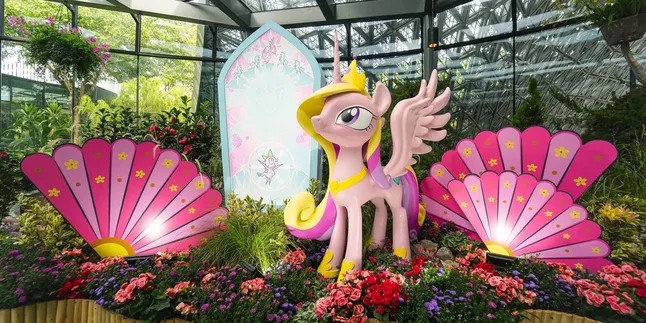
Don't forget to stop by the pop-up store to hunt for exclusive My Little Pony merchandise, so this family vacation is not only fun but also has sweet memories to take home.

Art lovers gather, Singapore Art Week 2026 is ready to make moments in Singapore more artsy!

Visiting VERSE 2026 feels like discovering a creative oasis in the middle of the city, perfect for those who want to travel to Singapore with a more personal, aesthetic, and inspiring experience from the very first day of the new year.

What are the recommendations for heist movies? Here is a list of exciting and challenging heist movie recommendations, perfect for those of you who love adrenaline.

In romance anime, you might find many sweet and affectionate scenes like kisses. It's understandable that many people are looking for recommendations for romance anime kisses to watch.
