

 Follow
 Rekomendasi
10 Movies That Make You Want to Go Home, Presenting Meaningful Family Stories
From Kesha's dilemma to a spiritual journey, discover 10 movies that make you want to go home with touching stories about family.
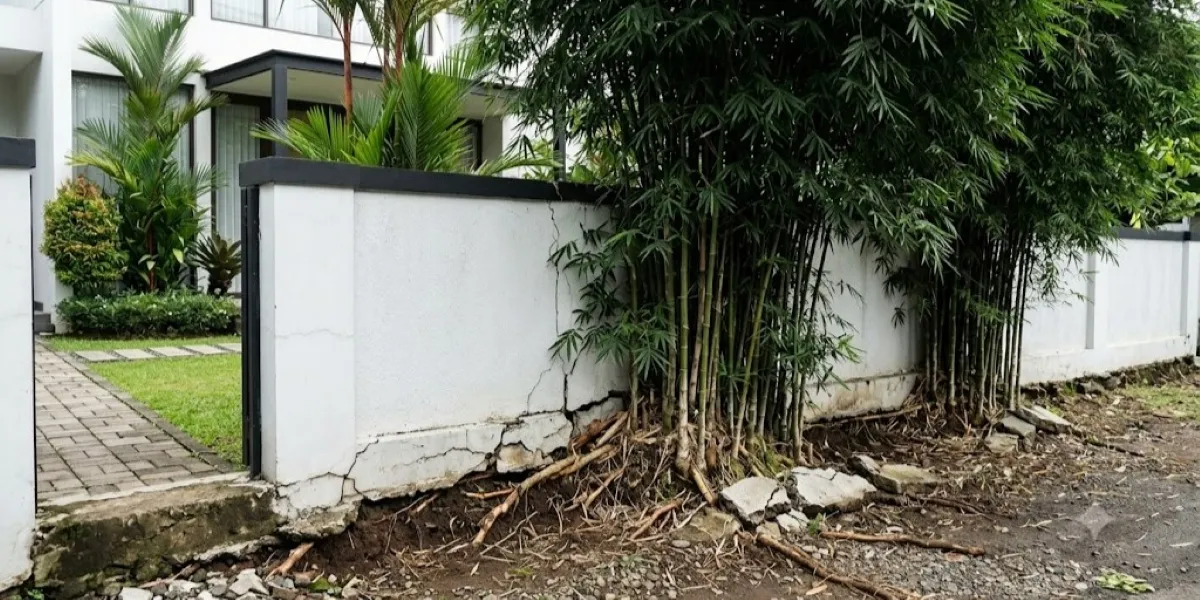
Kapanlagi.com - Having a lush garden is a dream, but the selection of vegetation must be done carefully to avoid damaging the building structure. According to a study in the journal Science of the Total Environment titled "Root damage of street trees in urban environments" (2023), the roots of certain trees have biomechanical strength that can penetrate concrete and drainage pipes. Therefore, it is crucial to know which types of plants should not be planted near fences to avoid costly renovation expenses in the future.
The best prevention is to understand the characteristics of the "root zone" of each species before purchasing seedlings. Installing HDPE root barriers can be a technical solution, but limiting the types of plants is much more effective and cheaper.
Here is a review of combinations of green plants and flowers so that the garden does not look crowded from various sources Tuesday (4/8/2026).
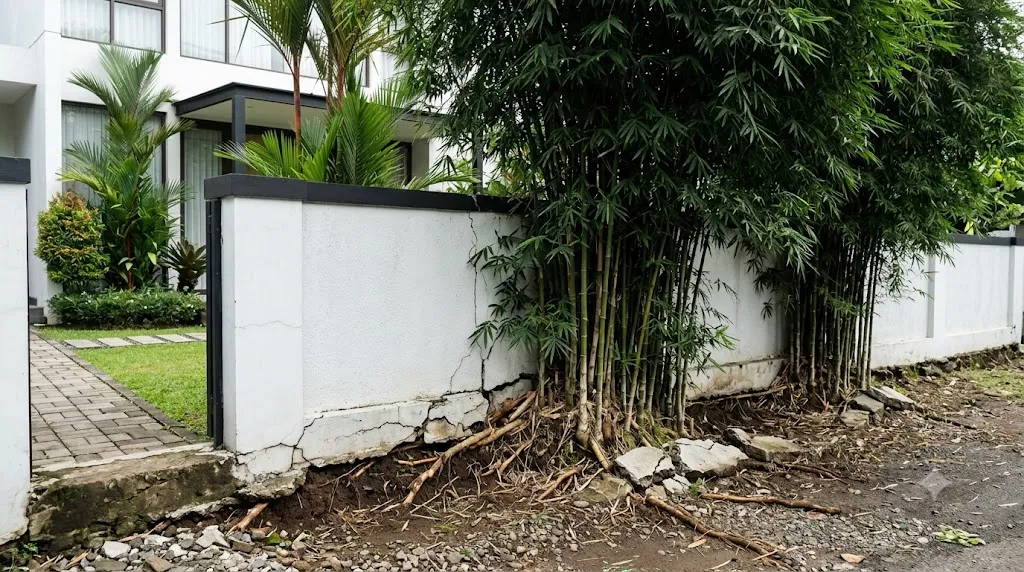
Bamboo (Bamboo spp.) (AI Generated)
Running bamboo is the main enemy of fence structures due to its very aggressive underground spread. The rhizomes of bamboo have sharp tips that can penetrate asphalt and even low-quality concrete if not restricted by a strong physical barrier at least 60 cm deep.
It is advisable to choose clumping bamboo if you still want a tropical feel, but maintain a distance of at least 1 meter from the fence.
Running bamboo can "walk" up to 1-2 meters per year, pushing the fence foundation to severe cracks in a short time.
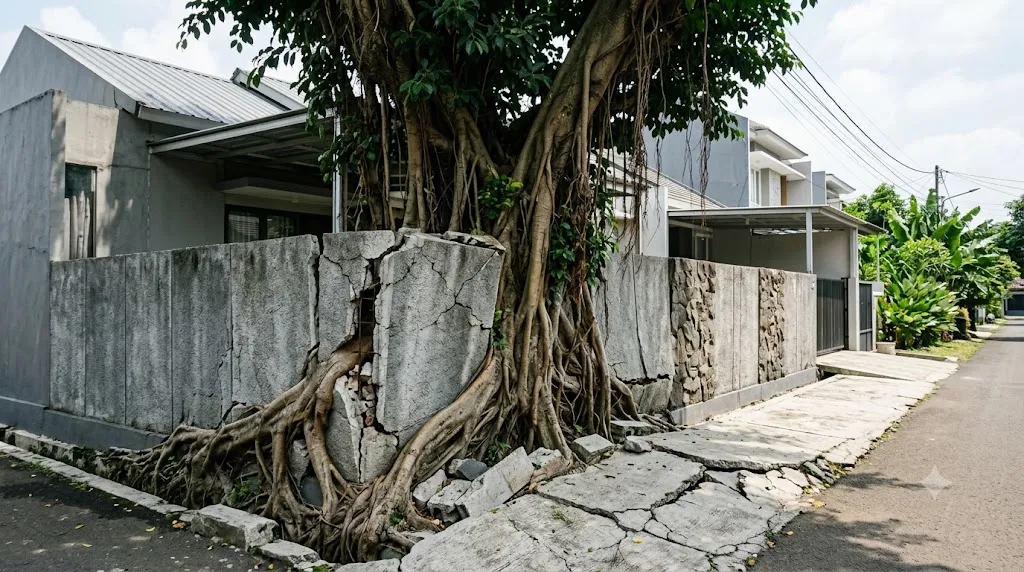
Banyan Tree (Ficus benjamina) (AI Generated)
Known as a legendary shade plant, the banyan tree has the most destructive root system for surrounding buildings. Its aerial roots that reach the ground will turn into hard wood trunks that continue to grow, lifting the fence foundation and damaging sidewalks with massive force.
In densely populated residential areas, planting banyan trees close to fences is a recipe for disaster as their roots aggressively seek water sources. Fine roots can infiltrate wall cracks, then grow larger and destroy the structure from within (wedging effect), as explained in urban botanical research.
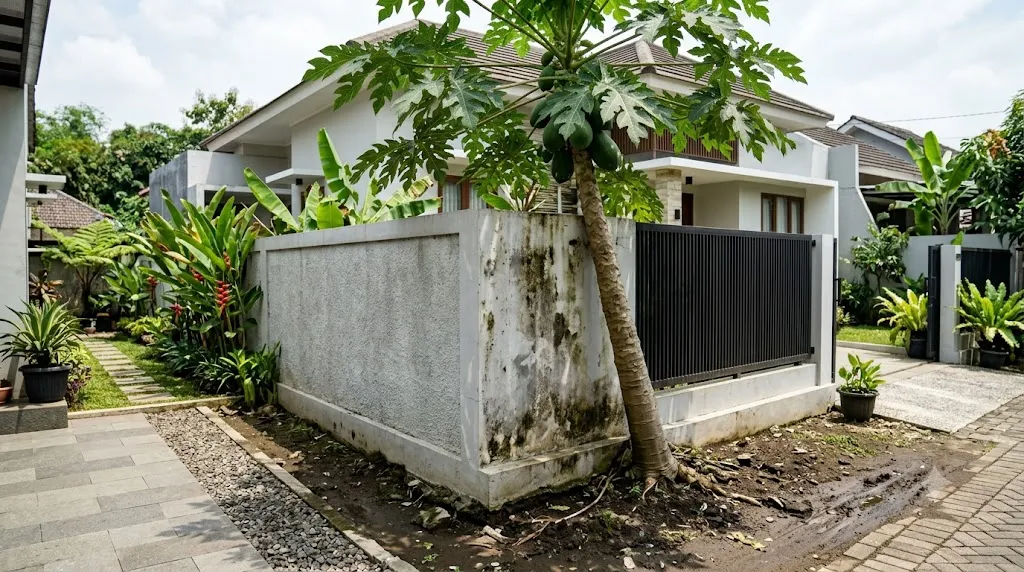
Papaya Tree (Carica papaya) (AI Generated)
Although appearing soft and short-lived, papaya trees are highly discouraged from being planted close to fence walls. Papaya roots require a lot of water and make the soil around the foundation loose or hollow, which can lead to ground subsidence beneath the fence.
The water-filled trunk of the papaya is also at risk of rotting and collapsing onto the fence during extreme weather or strong winds. Additionally, the high moisture generated in the papaya root area can trigger the growth of mold that damages your fence paint and cement coating.
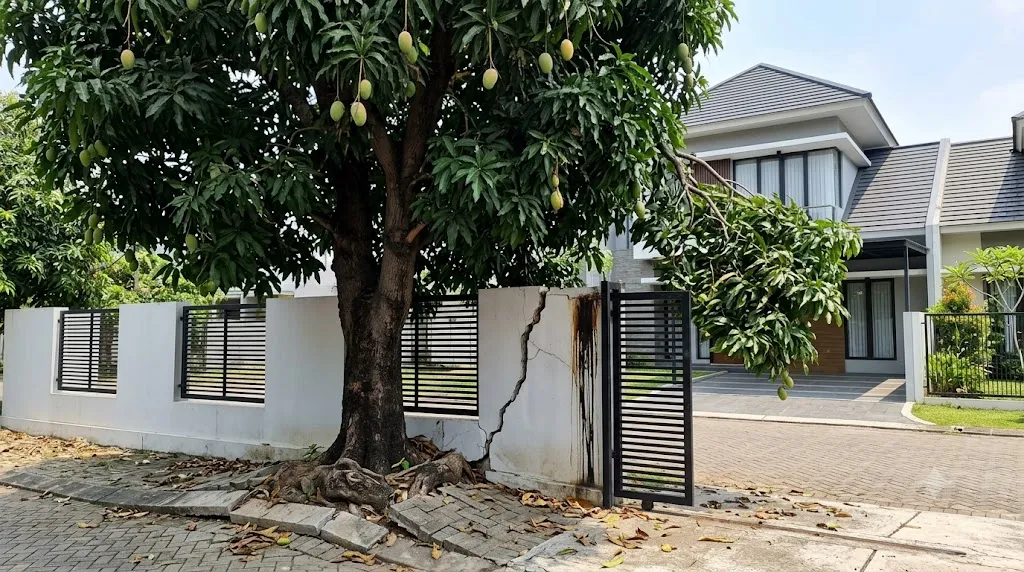
Mango Tree (Mangifera indica) (AI Generated)
The mango tree is a family favorite in Indonesia, but its taproot and lateral root system are very strong and expansive. If planted less than 3 meters from the fence, the large lateral roots will lift the soil and the fence foundation structure, causing difficult-to-repair vertical cracks.
The wide canopy of the mango tree also often crosses into neighboring land, triggering social conflicts and leaf litter issues.
The sap dripping from the mango tree can damage iron fence paint or natural stone coatings, leaving permanent black stains.
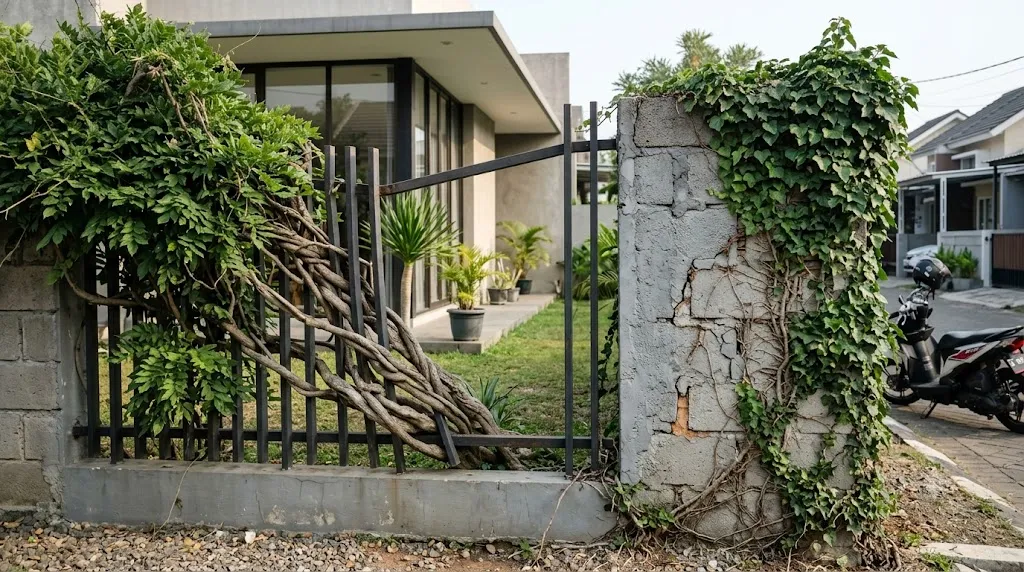
Heavy Climbing Plants (Wisteria/English Ivy) (AI Generated)
Climbing plants like Wisteria or English Ivy are often chosen for their classic aesthetics, but they are "slow killers" for wooden fences and walls. Their aerial roots cling very tightly to wall surfaces, eroding the mortar between bricks over time.
The biomass weight of these plants when mature is very heavy and can topple wooden or iron fences that are not designed for additional load. Wisteria, in particular, has a twisting stem that can crush wooden support posts or bend iron fence trellises as it grows.
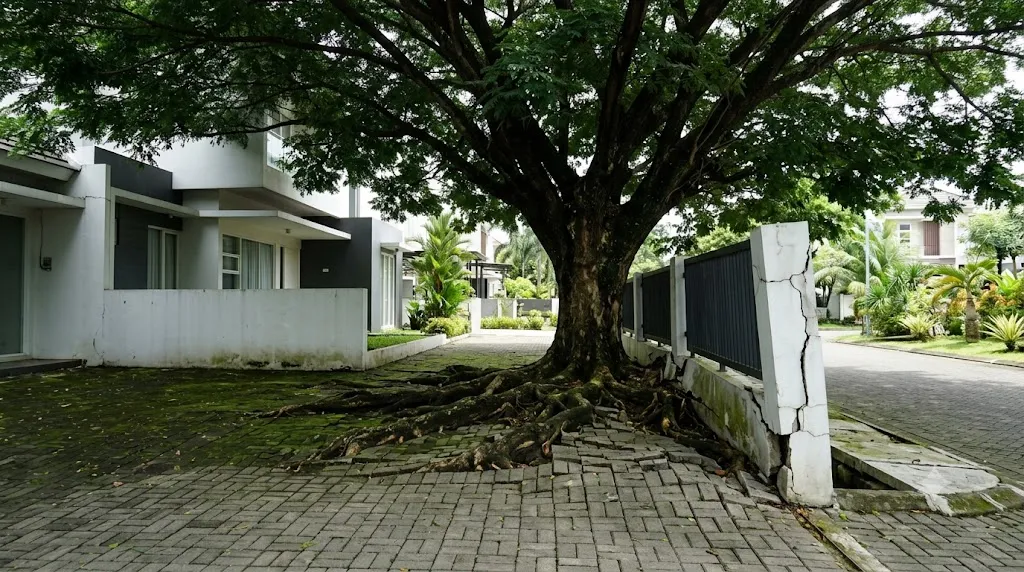
Rain Tree (Samanea saman) (AI Generated)
Trembesi or Rain Tree is a giant water absorber that should only be planted in city parks or very large areas. Its surface-rooting roots are highly invasive and can easily lift paving blocks and crush concrete fence foundations within a radius of several meters.
The expanding canopy of the trembesi (which can reach 30 meters) will block sunlight, making the fence area damp and mossy. Its large branches are also prone to breaking without warning (self-pruning branches), which is very dangerous for the fence structure and pedestrian safety nearby.
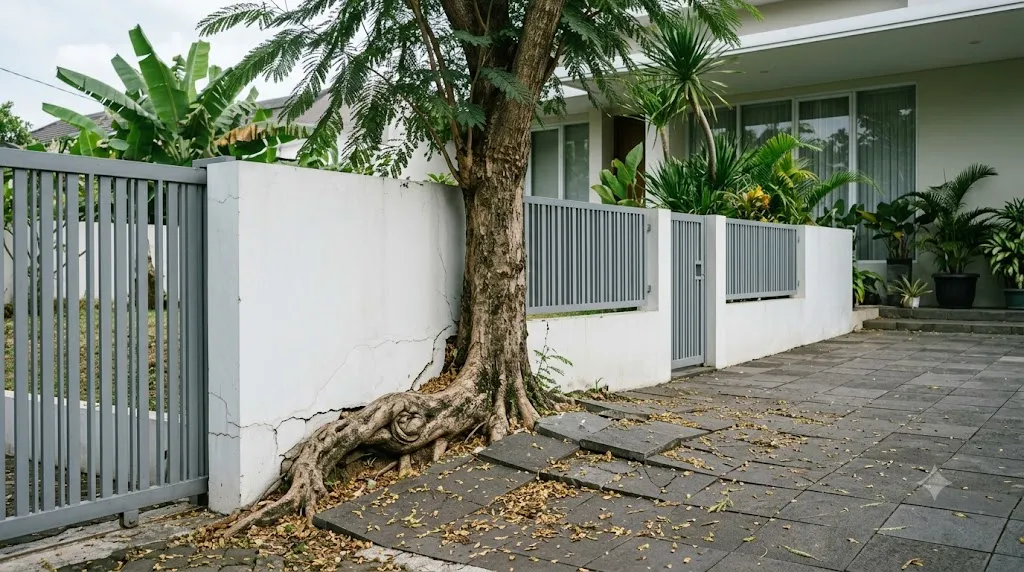
Acacia (Acacia mangium) (AI Generated)
Acacia is known as a tree that grows very quickly with relatively brittle wood and a shallow but widespread root system. Its surface roots often protrude above the ground, which can physically push against the lower fence structure and damage the aesthetics of the yard due to uneven flooring.
In addition to the root risk, acacia has the potential to become an invasive plant (weed) through its massive seed dispersal. Its fallen leaves in large quantities contain tannins that can stain carport floors or light-colored fence walls, adding to the daily maintenance burden for homeowners.
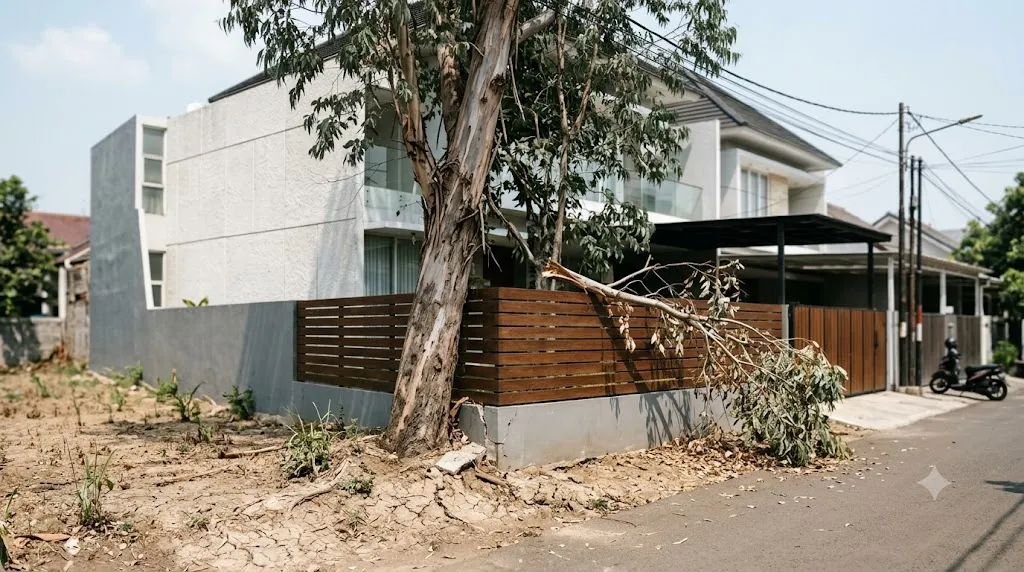
Eucalyptus (Eucalyptus spp.) (AI Generated)
Eucalyptus has a very thirsty lateral root system for water and nutrients, often "stealing" the share of other plants and drying out the soil around the fence foundation. Soil that is too dry (shrinking) around the foundation can cause soil structure shifts that make the fence unstable.
Known as the "widow maker," eucalyptus branches often fall suddenly, posing a risk of hitting the fence or people underneath.
The allelopathic substances released by its roots inhibit the growth of other ornamental plants around the fence, making the garden barren.
Large fruit trees like mangoes have an extensive and strong root system that supports the weight of the tree and its fruit. These roots grow laterally (sideways) and have enough biomechanical strength to lift or break the concrete foundation of a fence if the planting distance is too close (less than 3-4 meters). Additionally, canopies that extend beyond the fence often cause legal and social issues with neighbors due to leaf litter and privacy disturbances.
If the tree is already large, the short-term solution is to professionally perform root pruning on the side facing the fence, followed by the installation of a vertical root barrier made of HDPE plastic or waterproof concrete. However, this risks making the tree unstable. The safest long-term solution is to relocate the tree (if still possible) or cut it down and replace it with a species that has fine, non-invasive fibrous roots.
The safest plants are shrubs or bushes with non-aggressive fibrous roots, such as Red Shoot (Syzygium myrtifolium) or Teh-tehan. For climbing plants, the Dollar Plant (Ficus pumila) can be used on concrete walls, but it must be pruned regularly to prevent it from becoming too thick and heavy. Another safe option is potted plants (container gardening) arranged along the fence, so that root growth is fully controlled and does not touch the foundation soil.
(kpl/ibr)
Cobain For You Page (FYP) Yang kamu suka ada di sini,
lihat isinya
From Kesha's dilemma to a spiritual journey, discover 10 movies that make you want to go home with touching stories about family.

The phenomenon of dramas that raise relationship standards is not just a joke. Learn how these fictional shows shape expectations, from ideal characters to healthy relationship dynamics.
Movies with the best character development present an impressive emotional journey. Check out the film recommendations below.
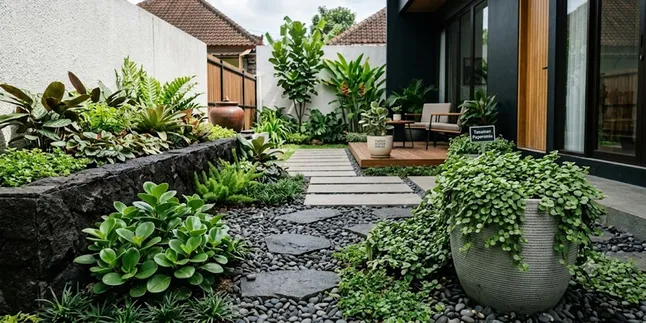
Small-leaved plants are ideal for minimalist gardens, creating a neat and fresh impression without taking up much space. Discover Peperomia, Fittonia, and Zebra Succulent, complete with characteristics and care tips.

Looking for travel-themed movies? Check out 15 movies about traveling around the world that offer exciting adventures, unique cultures, and beautiful panoramas.

Looking for a calming watch? This selection of Korean dramas features light storylines with minimal conflict, perfect for unwinding and filling your free time.
Explore 11 films about climate disasters that depict various perspectives on the environmental crisis, interesting to watch.

Movies about stalkers that send chills down your spine are a great choice for fans of psychological thrillers full of tension.

Interested in 'Teach You a Lesson'? Check out similar Korean drama recommendations that tackle issues of school violence, corruption, and intense revenge.
Is your bitter melon plant predominantly producing male flowers and rarely bearing fruit? Check out 8 ways to plant bitter melon so that there are not too many male flowers, from pruning, fertilizing, to sunlight.

Money dysmorphia is a psychological condition in which a person has a distorted perception of their financial situation, triggering anxiety and unhealthy financial behaviors.
Beautify your home yard by creating a green fence from climbing plants that are easy to apply and require minimal maintenance.
