

 Follow
 Rekomendasi
6 Items That Are Often Placed in the Wrong Spot and Make Your Home Messy Quickly
Discover a list of items that are often placed in the wrong spot and make your home messy quickly, complete with easy tips to tackle them every day.
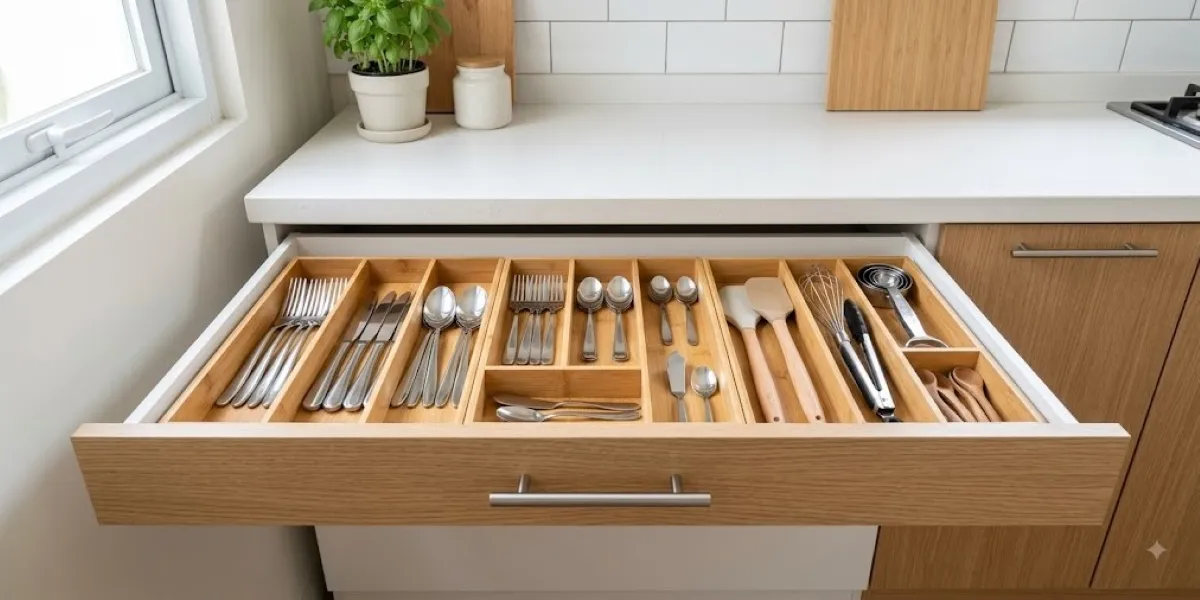
Kapanlagi.com - Kitchen drawers often become one of the areas in the house that gets messy the quickest, even right after being tidied up the day before. Spoons, forks, small cooking tools, and other supplies mix together every time they are used. Therefore, many people are starting to look for practical tricks to organize kitchen drawers so that the neat condition can last longer without having to be rearranged every week.
A messy drawer not only makes the kitchen look less comfortable, but it also slows down daily cooking activities. Time that should be spent preparing ingredients is wasted rummaging through the drawer to find a specific tool. This habit ultimately makes kitchen routines feel more exhausting than they should.
Here are some tricks to organize kitchen drawers so they don't get messy every day, summarized by KapanLagi.com from various sources, Thursday (13/8/2026). Apply these tips at home to make your kitchen look neater. Let's check out the full review below.
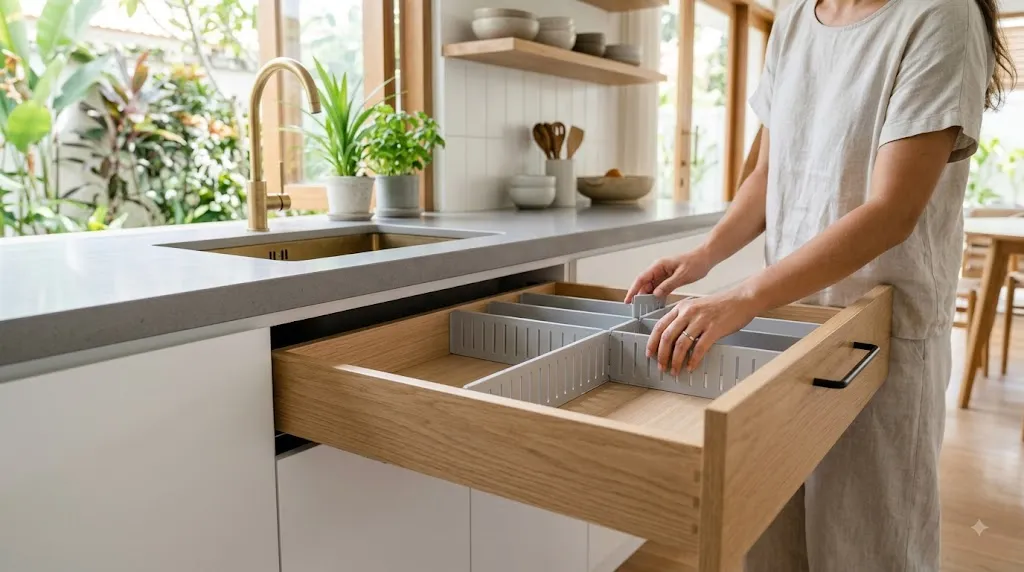
Use Drawer Dividers According to Size. (Image: AI Generated)
Dividers or separators are the most basic solution to prevent small utensils from piling up inside the drawer. With dividers, spoons, forks, and other cooking tools have their own spaces, so they don't easily mix even when the drawer is frequently opened and closed throughout the day.
The choice of dividers should be adjusted to the size of the drawers in the home, not just following the currently popular models. Adjustable-length plastic dividers are a flexible option because they can accommodate various dimensions of kitchen drawers.
Using the right dividers also speeds up the cooking process because each tool can be found without having to rummage through the entire contents of the drawer. This habit indirectly creates a more disciplined storage pattern in the long term.
Grouping items according to their function is an important step to prevent kitchen drawers from being filled with mixed-up tools without order. Eating utensils, cooking tools, and other small supplies should ideally be placed in different sections even if they are in the same drawer.
This grouping helps family members quickly recognize the position of each item, especially when the kitchen is being used by more than one person. A consistent system makes the habit of returning items to their original place easier to perform.
In addition to speeding up searches, grouping by function also reduces the risk of sharp objects rubbing against other tools. This condition helps maintain the quality of kitchen tools so they do not wear out quickly due to repeated friction.
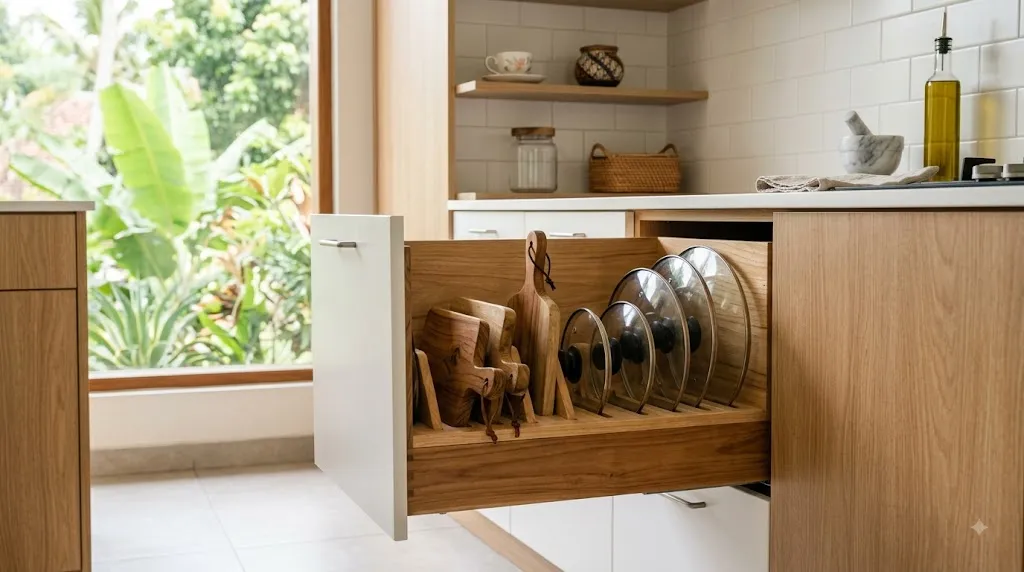
Utilize Tiered Racks for Thin Items. (Image: AI Generated)
Small cutting boards, pot lids, and thin trays are often difficult to organize neatly if simply stacked in a drawer. Vertical dividers can be a solution because they allow thin items to be stored upright, rather than stacked horizontally.
The upright position makes it easier to grab each item without having to move other items on top of them. This method also reduces the risk of scratches on the surface of cutting boards or trays, which are usually susceptible to scratches due to friction when stacked.
This vertical arrangement is suitable for deep drawers or special drawers under the stove. Space that previously felt cramped can be utilized more optimally with such a storage system.
Cookie cutters, seasonal cooking tools, or small party supplies should not be stored with items that are used daily. These items are better placed in a separate drawer to avoid cluttering the main drawer.
This separation keeps the daily drawer tidy as it only contains tools that are truly needed on a regular basis. A kitchen that is frequently used for daily cooking will greatly benefit from such a separation system.
A special drawer for seasonal tools also makes the search process easier when certain moments arrive, such as during holidays or family events. Items do not need to be searched in various corners of the kitchen because they already have their own designated space.
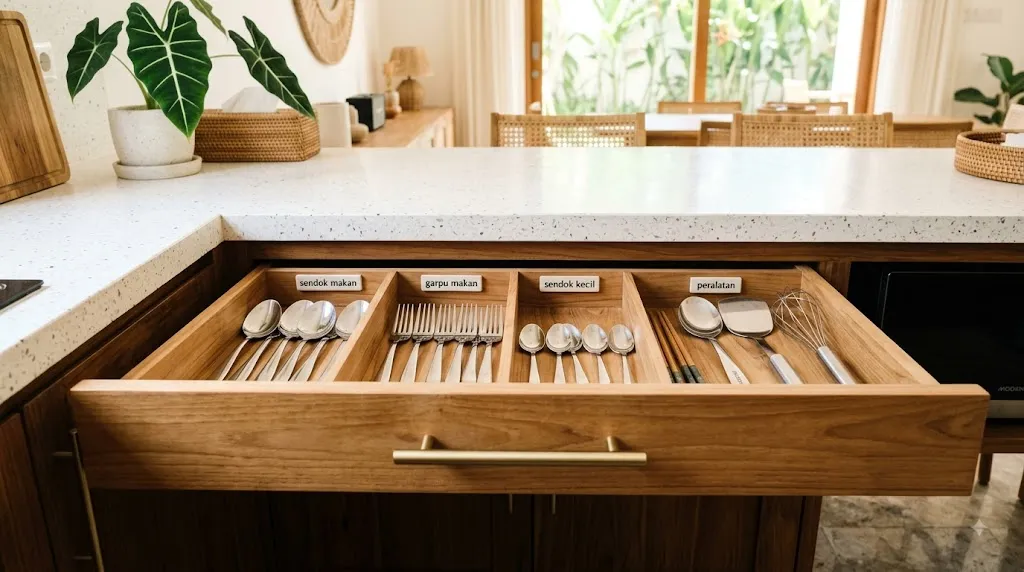
Label Each Compartment. (Image: AI Generated)
Small labels on each drawer compartment help ensure that items always return to their original position after use. This habit is especially useful in homes with many family members who also use the kitchen.
Without labels, the organization system that has been created often becomes messy again within a few days because each person puts items according to their own habits. Simple labels can significantly reduce that confusion.
Label writing does not need to be complicated; just include the name of the category such as spoon, fork, or small cooking tools. This method has proven effective in maintaining the consistency of kitchen drawer organization over a longer period.
Bent spoons, containers without lids, or cooking tools that are rarely touched often remain stored in drawers unnoticed. Items like these only take up space without providing any benefit in daily cooking activities.
Regularly checking the contents of the drawers and removing tools that are no longer usable is an important step to keep the space clear. This habit also helps avoid the accumulation of items that continues to grow over time.
A clearer drawer space makes it easier to implement a compartment system and group items effectively. The kitchen also feels more organized because it only stores tools that are truly still in use.
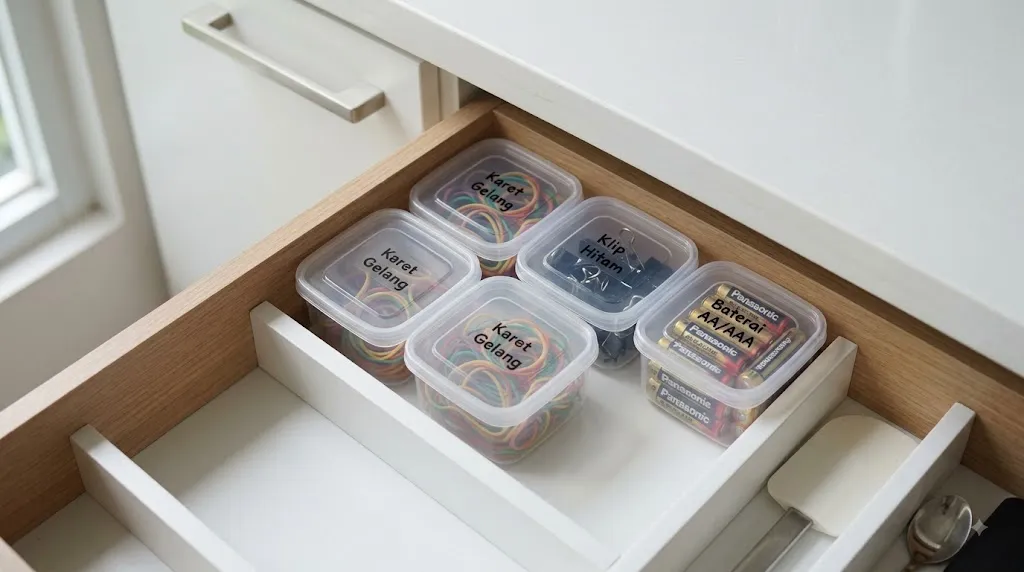
Use Small Containers for Mini Sized Items. (Image: AI Generated)
Rubber bands, plastic clips, spare batteries, and other small items tend to get scattered if left loose in a drawer. Small containers can be a simple solution to keep mini-sized items from being misplaced.
Placing small containers in one corner of the drawer makes these items easier to find without having to rummage through the entire contents of the drawer. This system also prevents small items from getting lost among larger tools.
Used containers such as small jars or leftover plastic packaging boxes can be utilized for this purpose without the need to buy new supplies. This simple method has proven effective in keeping the drawer organized.
The addition of new utensils without removing old items is one of the main causes of kitchen drawers filling up quickly again. Implementing the one-in-one-out rule can help keep the number of utensils under control.
Whenever you buy new utensils, it is advisable to set aside one old item that is rarely used to be removed. This habit prevents the drawer from being filled with items shortly after being organized.
This simple rule also encourages a more selective habit when purchasing new kitchen utensils. Only items that are truly needed will be kept, while excess items will no longer accumulate without a clear reason.
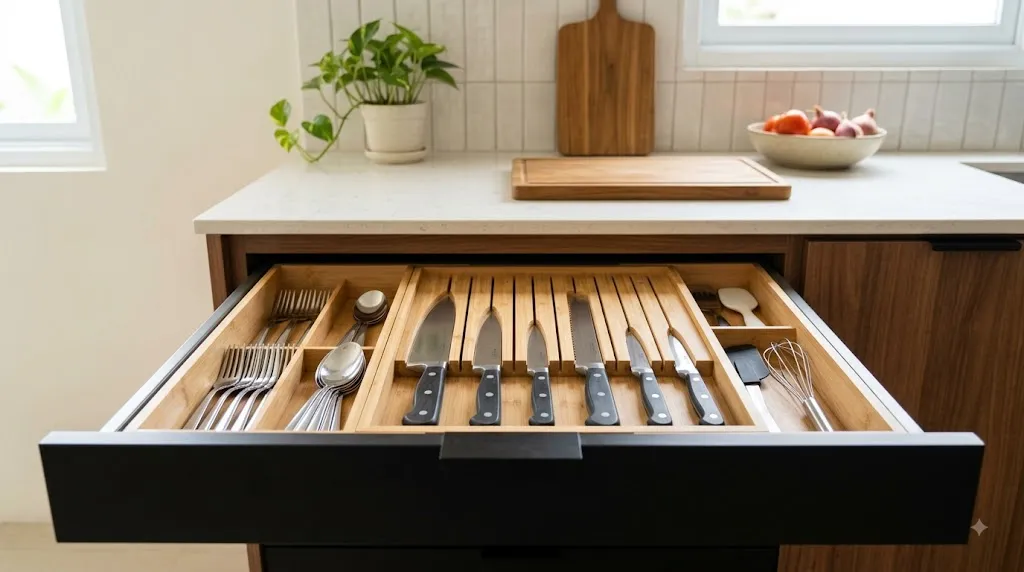
Store the Small Knife in a Separate Place. (Image: AI Generated)
Knives or other sharp tools ideally have their own storage slot, separate from the spoons and forks that are commonly used daily. This separation is important to reduce the risk of cuts when hands rummage through the contents of the drawer without looking directly.
Some modern drawer dividers are already equipped with specially designed elongated slots for safely storing small knives. The organized position of the knives also makes them last longer as they do not rub against other metal utensils.
The habit of separating knives from other utensils should be implemented from the beginning of the drawer organization. This system provides a greater sense of safety, especially in homes with children who also open kitchen drawers.
No matter how good the organization system is, it will become messy again if not balanced with the habit of tidying up regularly. Spending a few minutes each week to check the condition of the kitchen drawer can prevent items from piling up unnoticed.
Routine checks also provide an opportunity to reevaluate the position of dividers and the grouping of items that have been previously implemented. Small adjustments are sometimes necessary as new kitchen tools are added.
The habit of tidying up drawers periodically ultimately creates a more organized lifestyle, not only in the kitchen area but also in other storage spaces in the house. Consistency is the key to ensuring that the results of the organization last long.
How to organize a kitchen drawer to avoid clutter? Organization can start by using dividers that fit the size of the drawer, grouping items by function, and getting into the habit of tidying the drawer regularly every week to maintain the system that has been established.
What tools are needed to organize a kitchen drawer? The common tools include drawer dividers, small containers for mini items, and vertical dividers to store cutting boards or pot lids in an upright position to save space.
How often should kitchen drawers be reorganized? Ideally, checking and tidying kitchen drawers should be done weekly so that items that begin to shift or pile up can be rearranged before they become too messy.
Are dividers necessary for all types of kitchens? Drawer dividers are highly recommended for all types of kitchens, whether small or large, as they help prevent utensils from piling up and make it easier to find items.
How to store knives safely in a drawer? Knives should be stored in a dedicated slot separate from spoons and forks, either using elongated dividers or a separate container, to reduce the risk of getting scratched when retrieving other utensils.
(kpl/bim)
Cobain For You Page (FYP) Yang kamu suka ada di sini,
lihat isinya
Discover a list of items that are often placed in the wrong spot and make your home messy quickly, complete with easy tips to tackle them every day.

How to care for orchids to bloom quickly with a complete guide on lighting, watering, fertilizing, and the ideal temperature for maximum results.

Rust on home fences can be addressed without repainting. Learn practical guidelines for cleaning rust with natural materials, mechanical methods, and special products for a clean and well-maintained fence.

How to grow romaine lettuce at home, from choosing seeds to harvesting fresh and crunchy leaves.

Avoid tomato fruit rot by understanding its causes and applying the right cultivation strategies, from variety selection to intensive care for quality harvests.

Caring for monstera to ensure its leaves are large and healthy can be done by paying attention to light, watering, planting media, and humidity.

Discover effective ways to care for the Tabebuya tree to encourage frequent flowering with these eight easy steps.

Recommendations for indoor plants that not only beautify the home but are also safe for children and pets.

Here's how to plant cosmos in your yard to ensure they grow lush, healthy, and bloom frequently with the right care.
Learn the ideal boiling duration for quail eggs for various levels of doneness, from soft-boiled to perfectly cooked, as well as practical tips for easy peeling.
Fixing soft rice to make it fluffy can actually be done with a few simple steps. Check out the causes and tips to ensure the rice always turns out just right.

22 plants for summer that keep blooming even with rare watering can be the right choice to beautify the garden without complicated maintenance. Check out the recommendations.
