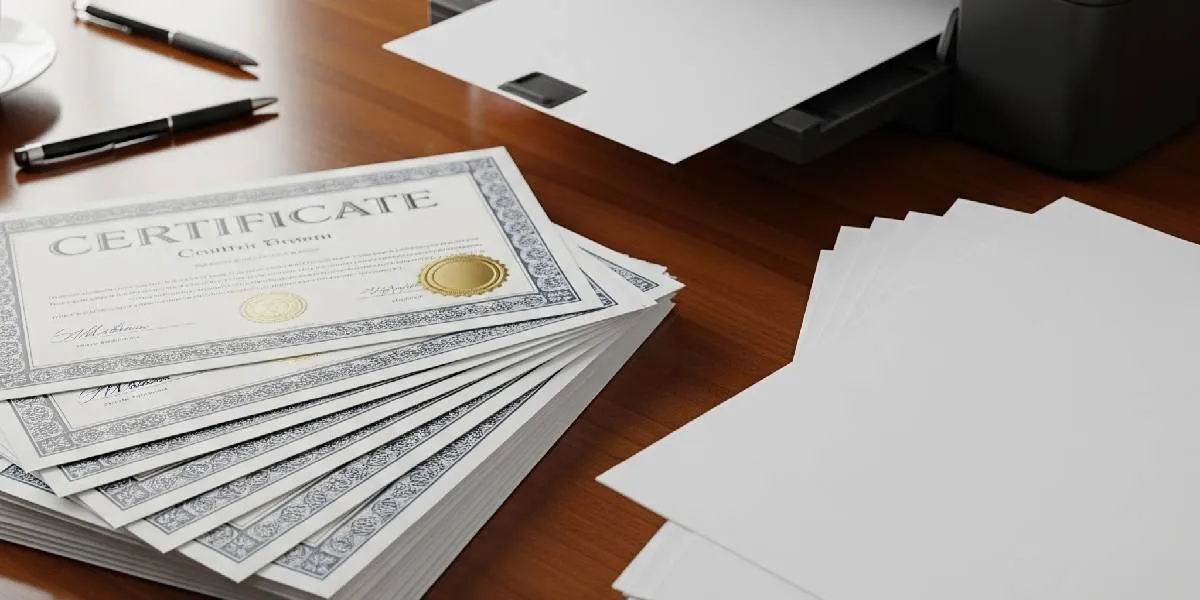
Kapanlagi.com - Choosing the type of paper for certificates is not just about appearance, but also determines the quality of the document in the long term. Certificates printed on the right paper will look neater, have an official impression, and will be more durable when stored for years.
As a document that serves as proof of achievement, certificates are often kept as personal archives or important documents. Therefore, the paper material used needs to maintain print quality while also providing a professional impression to the recipient.
Choosing the right paper is one of the main factors that determine the durability, value, and exclusive impression of a certificate. In addition to design, the quality of the material also plays a significant role in creating a document that is worthy of being an award or official proof.
1. Understanding the Function of Certificates and the Reasons Why Quality Paper is Very Important
According to the Great Dictionary of the Indonesian Language (KBBI), a certificate is a letter of statement or written declaration, whether printed or not. In its use, this document serves as proof of ownership, achievement, or an event published by an authorized party.
Certificates are used in various fields, ranging from education, professional training, competition awards, organizations, to government institutions. Although their functions are diverse, all these documents require print media that can represent the value of the recognition given.
The quality of the paper is also the first thing felt when someone receives a certificate. Thick paper with a distinctive texture can provide a more official impression compared to ordinary thin paper that is easily folded.
Associated Imaging Solutions also mentions that using acid-free cotton paper is a good choice to keep important documents durable so that they can still be enjoyed by future generations.
2. Characteristics of Certificate Paper That Should Be Selected
Before determining a specific type of paper, there are several basic characteristics that need to be considered to ensure that the printed result meets the standards of official documents.
The Hague Group explains that paper weight, surface texture, color, durability, compatibility with printing machines, the use of watermarks, and environmental friendliness are factors that need to be considered when selecting certificate paper.
Thickness is one of the main differentiators between certificate paper and regular paper. Grammage or GSM (grams per square meter) indicates the level of thickness. Generally, certificates use paper in the range of 120–250 GSM, while standard HVS paper is only around 70–80 GSM.
In addition to thickness, texture also adds value. There are papers with a smooth surface, as well as those with textures like linen or parchment. These textures provide a visual experience and a touch that makes the certificate feel more exclusive.
The base color also affects the final appearance. White remains the most common choice because it easily matches various designs. Meanwhile, cream or off-white colors can provide a warmer feel without reducing the formal impression.
Another factor that is often overlooked is the acid-free property. This type of paper is more resistant to yellowing and deterioration, making it suitable for documents that will be stored for a long time. Associated Imaging Solutions also mentions that granite paper can provide a stronger visual appearance for important documents.
3. The Most Commonly Used Types of Certificate Paper
Not all paper is designed for printing certificates. To achieve a more professional result, paper with a higher grammage and specific characteristics according to needs is usually used.
1. Linen Paper
Linen paper is one of the most popular choices because it has a texture resembling linen fabric with a fine embossed pattern. Its grammage ranges from 220–250 gsm, making it sturdy enough for diplomas and company certificates.
In addition to easily absorbing ink, this paper is also suitable for documents that still require manual signatures.
2. Concorde Paper
Concorde falls into the fancy paper category, which has a fine striped texture that gives an elegant impression. Grammage options range from 160 gsm, 220 gsm, to 250 gsm.
Due to its luxurious appearance and soft color options, this type is often used for award certificates.
3. Art Carton
Art Carton has a smooth surface with bright white color, allowing for sharp color prints.
Grammage options range from 190 gsm to 310 gsm. However, the glossy surface makes it less suitable if the certificate still needs to be signed with a pen. To enhance the print results, either glossy or matte lamination can be added.
4. Parchment Paper
Parchment is known for its distinctive patterns that give a classic feel to certificates. Besides looking unique, this paper is also known to be strong and durable.
This type is compatible with laser printers, inkjet printers, photocopiers, and even typewriters. It's no surprise that parchment is widely used by universities and international government institutions.
5. BW (Blues White) Carton Paper
BW Carton offers a smooth surface without a glossy effect with a weight of around 250 gsm.
Because it is not glossy, this paper is suitable for certificates that require wet signatures. The print quality remains good even though it is more economical compared to some other types of fancy paper.
6. Hammer Paper
Hammer Paper has a textured finish combined with a glossy surface, giving a premium impression to certificates. This type of paper is often chosen for award documents that want to appear more exclusive.
The color options are quite varied, such as pearly white, dark brown, green, and yellow. When combined with embossed ink or gold foil, the appearance becomes even more striking. Due to its quality, the price of Hammer paper is generally higher compared to some other types of certificate paper.
7. Ivory Paper
Ivory paper is known for its smooth surface with a cream or off-white color. This characteristic makes certificates look clean and elegant.
The grammage of ivory used typically ranges from 210 to 400 gsm. This thickness makes it strong enough to be displayed in a frame or stored as long-term archival material.
8. Laid Paper
Laid paper has distinctive features in the form of horizontal and vertical lines that create a texture resembling handmade paper.
This texture provides a different visual and tactile experience compared to regular paper. Due to its artistic appearance, laid paper is widely used by art institutions and creative organizations for printing certificates.
4. Determining the Grammage of Certificate Paper According to Needs
In addition to choosing the type of paper, the gram weight also needs to be adjusted according to the function of the certificate. Gram weight or GSM indicates the weight of the paper per square meter and serves as an indicator of its thickness.
According to Snap Print Solutions, understanding the value of GSM helps determine the quality of the printed material because it affects the strength of the paper as well as the comfort when held.
For simple needs, paper with a gram weight of 100–160 gsm can still be used, for example for internal activity certificates or casual events with a limited budget. However, this thickness level does not convey a professional impression like that of special certificate paper.
The range of 190–230 gsm is the most commonly used choice. Paper in this category is sturdy enough not to easily fold and is suitable for training certificates, awards, or documents that are stored in folders or frames.
Meanwhile, a gram weight of 250–310 gsm gives a more premium impression. Its thicker weight makes the certificate feel more exclusive, so it is often chosen for diplomas, official awards, or important documents presented directly to the recipient.
If the gram weight exceeds 310 gsm, the character of the paper starts to approach cardboard. This type produces very sturdy certificates and has better durability for long-term storage.
The choice of gram weight should also consider the printing process. Certificates that still require manual signatures are better suited to use a matte surface so that the ink does not easily smudge. On the other hand, when the entire content of the certificate has been printed without the need for additional signatures, a glossy surface can be an alternative.
The type of printer also determines the final result. For textured papers like linen or concorde, laser printers and offset printing machines generally produce more optimal prints compared to home inkjet printers because toner can adhere more evenly to the surface of the paper.
5. Finishing That Makes Certificates More Attractive and Secure
The quality of a certificate is not only determined by the type of paper but also by the finishing process after printing. Various additional techniques can enhance the appearance while providing protection to the document.
One of the most commonly used finishings is gold foil stamping or other metallic foils. According to Corcoran Printing, this technique can create a shiny effect that gives an elegant impression to certificates and diplomas.
Embossing and debossing are also widely chosen to highlight the logo or name of the institution. The raised or recessed effects produced make certain details look more exclusive.
The hot print or toning technique produces metallic colors like gold and silver on letters and logos. The final result makes the certificate look different from regular ink prints.
Lamination can be an option if the certificate requires additional protection from tearing or moisture. However, not all types of paper are suitable for lamination. Textured papers like Japanese Linen and BW Carton, for example, are less recommended for this process.
On the other hand, the use of QR codes is increasingly being applied as a security feature. The code facilitates the process of verifying the authenticity of certificates digitally.
Some institutions also add a watermark as an additional layer of authentication to make documents harder to forge, especially on official certificates and high-value documents.
Environmentally friendly material options are also starting to develop. The Royal Store mentions that paper made from sugarcane or tree-free materials is now available as an alternative that still produces a professional appearance. Additionally, FSC-certified paper is increasingly being used by organizations that implement sustainability principles.
6. Paper Size and Things to Consider Before Printing
The size of the paper also affects the final appearance of the certificate. The A4 format, measuring 210 × 297 mm, remains the most widely used standard because it is compatible with various printers and printing machines.
Besides A4, the Letter size of 216 × 279 mm is also quite popular. For certain events that desire a larger appearance, the A3 size of 297 × 420 mm can be an option.
The base color of the paper should not be overlooked. White gives a modern and formal impression, while cream or broken white provides a warmer feel. Whatever the choice, the graphic design and text color should still have good contrast for easy readability.
For those who want to print the certificate themselves, the design process can be done using various applications such as Microsoft Word, Microsoft Excel, Canva, CorelDraw, or Adobe Illustrator. Once the design is complete, the choice of paper type still needs to be adjusted to the needs, whether using parchment for a classic feel, matte card for an economical choice, or textured premium paper for a more exclusive result.
Ultimately, choosing the type of paper for the certificate is not only related to the visual appearance. The gram weight, texture, color, and finishing techniques all play a role in producing a more durable and valuable document. By considering all these aspects from the beginning, the certificate will appear more professional while also being able to serve as proof of achievement for a long time.
(kpl/mda)
Disclaimer: This translation from Bahasa Indonesia to English has been generated by Artificial Intelligence.


 Follow
 Rekomendasi