Kapanlagi.com - Determining the wattage of lights for a 3x4 room is not just about choosing the brightest light. A bedroom measuring 12 square meters requires sufficient lighting for activities, but it should also be comfortable for the eyes and support the quality of rest.
In general, a room of that size can use LED lights with a power of about 12–20 watts. The exact requirement is influenced by the efficiency of the light, the number of lumens produced, ceiling height, light color, and the desired level of illumination.
Referring to various lighting design guidelines, bedrooms generally require an illumination level of around 100–200 lux. This reference can be used to estimate the number of lumens needed so that the selection of lights becomes more accurate.
1. Understanding the Difference Between Watt, Lumen, and Lux Before Choosing a Light Bulb
Before determining the appropriate light, there are several basic terms that need to be understood. The three are interconnected but serve different functions in determining the quality of lighting.
"Good design is entirely about light," said Victoria Hagan, an interior designer, quoted from Coohom.
Watt (W) indicates the amount of electrical power used by the light. A higher watt value means greater electricity consumption, but it does not mean that the light automatically produces brighter light because each technology has different efficiencies.
Lumen (lm) is a measure of the amount of light emitted by the lamp. The higher the lumen number, the brighter the light produced.
Meanwhile, lux is used to measure the intensity of light received by a surface. One lux is equivalent to one lumen per square meter, so this unit is often used to calculate the lighting needs of a room.
In addition to these three terms, there is also lamp efficacy, which indicates the lamp's ability to convert electrical energy into light. Modern LED lamps generally have an efficacy of around 90–120 lumens per watt, with some products even exceeding those numbers.
Two other important terms are Kelvin (K), which is a measure of the color temperature of light, and CRI (Color Rendering Index), which indicates the lamp's ability to display the colors of objects accurately.
Referring to the Omni Calculator, the lumen requirement for a room is obtained by multiplying the desired lux level by the area of the room. This method makes the selection of lights more accurate compared to just relying on wattage alone.
2. How Many Watts for a 3x4 Room is Recommended?
A 3x4 meter room has an area of about 12 square meters. For main lighting, a 12–20 watt LED lamp is generally sufficient, while the range of 15–18 watts is the most commonly recommended option.
"Lighting is everything. Light can make a room feel warm, comfortable, and inviting, or cold and unwelcoming," said Jonathan Adler, an interior designer, as quoted by Coohom.
If converted to lumens, the lighting needs for such a bedroom range from 1,440 to 3,000 lumens, depending on the desired brightness. For a bedroom, softer lighting is generally considered sufficient, so there is no need to use excessively high wattage lamps.
Instead of installing one high-wattage lamp, distributing light to several points often provides a more comfortable result. One ceiling lamp with a wattage of 12–15 watts can be combined with smaller desk or reading lamps to achieve more even lighting without causing glare.
The choice of lamp wattage should also be adjusted according to the function of the room. If the room is primarily used for resting, a range of 12–15 watts is adequate. However, if the room is also used as a study or work area, using lamps up to 20 watts or adding task lighting can be a good option.
3. Calculating the Wattage Needs of Lights for a 3x4 Room
Determining the actual wattage of a lamp can be done with simple calculations so that the lighting results are more in line with the needs of the room. This method helps avoid using lights that are too bright or too dim.
The first step is to calculate the area of the room. For a room measuring 3 x 4 meters, the total area reaches 12 square meters.
After that, determine the lighting target or lux. Bedrooms generally fall within the range of 120–250 lux. If you want comfortable lighting for daily activities, a figure around 150 lux can be used as a reference.
The next stage is to calculate the lumen requirement by multiplying the area of the room by the target lux. In a room of 12 square meters with a target of 150 lux, the result is approximately 1,800 lumens.
This value is then converted into wattage requirements. If using LED lights with an efficacy of about 90 lumens per watt, the power requirement is around 20 watts.
This calculation also needs to consider the conditions of the room. Dark-colored walls tend to absorb light, so they usually require an additional 10-20 percent lumen. Similarly, ceilings that exceed about 2.7 meters in height require more lumen, increasing by about 15 percent due to wider light distribution.
If you want softer light, the target lux can be lowered to around 120 lux. Thus, the lighting requirement becomes around 1,440 lumens or equivalent to approximately 16 watts. In addition, utilizing sunlight during the day can also help reduce electricity usage.
4. The Color of Light from Lamps Also Affects Sleep Comfort
In addition to considering the wattage of the lamp, the choice of light color also plays an important role in creating a comfortable room atmosphere.
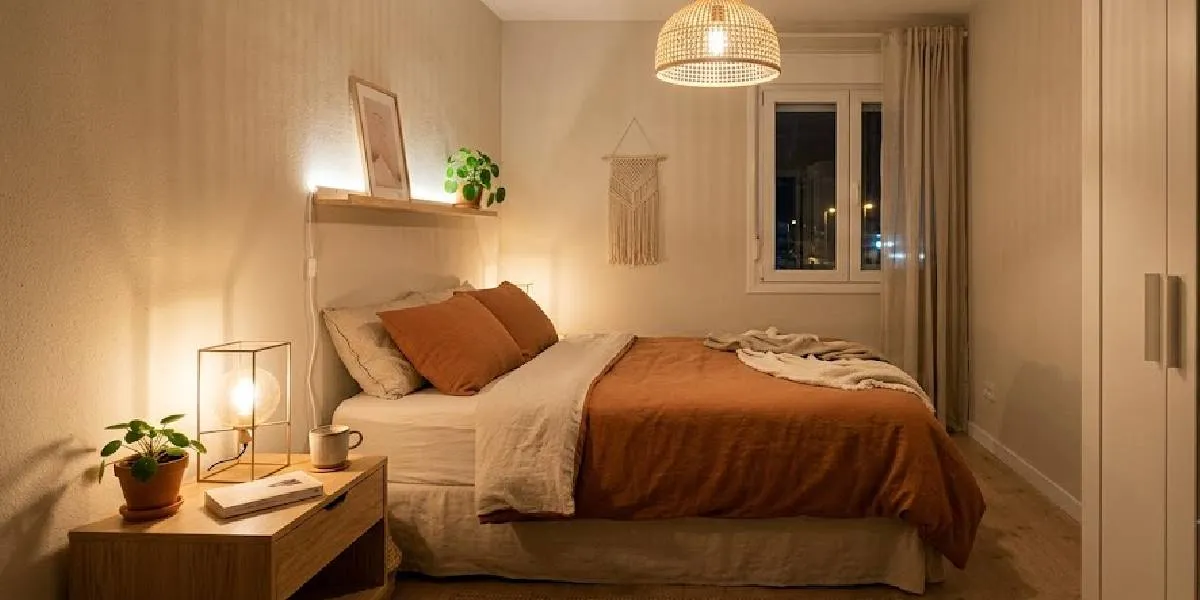
For bedrooms, warm white light with a color temperature of around 2700K to 3000K is the most recommended choice. This color brings a warm ambiance, making the room feel more comfortable for resting.
On the other hand, cool white or daylight light in the range of 4000K to 6500K is more suitable for study areas or workspaces that require higher concentration.
According to Decorilla, cool white light can indeed make a room appear brighter. However, this type of light can also make it harder for someone to fall asleep, making it less ideal as the main lighting in a bedroom.
The relationship between lighting and sleep quality is also related to the body's circadian rhythm. The Sleep Foundation explains that exposure to blue light before bedtime can suppress the production of melatonin, the hormone that helps the body feel sleepy.
"We found that the body's natural circadian rhythm is disrupted by short-wavelength-rich light, or what is known as blue light, from electronic devices," explained Anne-Marie Chang, a neuroscientist, quoted from Harvard Medical School.
Scientific American also mentions that changes in the biological clock due to light exposure can affect various organ functions, not just the sleep-wake cycle. Therefore, using lamps with warm light and reducing light intensity before sleep is one way to support the quality of rest.
Besides color temperature, light quality is also influenced by the Color Rendering Index (CRI). Lamps with a CRI of 90 or higher can display colors of objects closer to their original condition.
Using dimmers or lighting sensors can also help save electricity consumption by up to around 80 percent without reducing comfort.
"The sun never knows how great it is until its light strikes the side of a building," said architect Louis Kahn, quoted from Coohom.
Many people also combine main lights with wall lights or warm white accent lights to create a warmer and more comfortable atmosphere in the room.
5. Tips for Choosing a Comfortable and Energy-Efficient Light for a 3x4 Room
After determining the appropriate power range, the next step is to choose lights that can provide optimal lighting while being efficient in electricity usage.
"Design is determined by light and shadow, and proper lighting is very important," said Albert Hadley, an American interior designer, as quoted by LuxDeco.
When buying lights, don't just pay attention to the wattage. Also check the lumen value on the packaging because this measurement indicates the brightness level of the light. Two lights with the same wattage may not produce equivalent light intensity if their efficacy differs.
LED lights are a highly recommended choice because they are more energy-efficient compared to incandescent bulbs. For example, a 7-watt LED light can produce a brightness level equivalent to a 60-watt incandescent bulb, with electricity consumption lower by about 75–85 percent and a longer lifespan.
Layered lighting can also make a room feel more comfortable. In addition to the main light as a general light source, add reading lamps or table lamps for specific activities, as well as accent lights to create a warmer atmosphere.
If possible, use a dimmer or smart bulb so that the light intensity can be adjusted as needed. The light can be made bright when working or studying, then dimmed as it approaches break time.
The placement of lights is equally important. Avoid placing the main light directly over the bed as it can cause glare when lying down. For reading activities, use a lamp with an output of around 450 lumens, while bedside lamps are generally sufficient at a range of 220–450 lumens.
During the day, take advantage of natural light by opening curtains or windows to reduce the need for artificial lighting. This simple step can help lower electricity consumption while providing healthier lighting for the eyes.
Proper lighting can also be adjusted to fit the interior concept of the room. Warm white lights are often chosen to create a cozy atmosphere, while ambient lighting is used to give a different character to the room. On the other hand, uniform lighting remains a choice for rooms that prioritize functionality and comfort.
6. Important Things to Know Before Choosing a Lamp
Choosing a lamp for a 3x4 room is not just about the wattage. The size of the room, the number of lumens, the color temperature of the light, and the efficiency of the lamp all need to be considered together to ensure comfortable and energy-efficient lighting.
For a bedroom of 12 square meters, a 12–20 watt LED lamp is generally sufficient. A range of 15–18 watts is commonly used as the main lighting, while up to 20 watts can be chosen if the room is also used for studying or working.
If you want a more relaxed atmosphere, lamps with a warm white light at 2700K–3000K are recommended as they help create a warm ambiance. In contrast, bright white or cool white light is more suitable for areas that require high concentration.
Calculating lighting needs should also ideally use lumen and lux references, not just watt numbers. This approach will result in lighting that is more appropriate for the room conditions while avoiding energy waste.
By considering all these factors, a 3x4 meter room can achieve lighting that supports daily activities while remaining comfortable for resting.
(kpl/mda)
Disclaimer: This translation from Bahasa Indonesia to English has been generated by Artificial Intelligence.


 Follow
 Rekomendasi