Kapanlagi.com - The hot weather makes fans one of the most commonly used electronic devices at home. Since they are often on for hours every day, many people start to wonder how many watts a fan uses and how much electricity it actually consumes.
Understanding the power needs of a fanhelps estimate monthly electricity usage while also choosing devices that meet your needs. Compared to air conditioning units like ACs, fans are known to be much more energy-efficient, making them a popular choice for many households.
According to the Department of Energy, fans are effective air circulation devices that enhance comfort inside the home. Their operation does not lower the room temperature but creates airflow that provides a cooler sensation to the body.
1. Understanding the Electrical Power of Ceiling Fans and the Wattage Used
Watt is a unit that indicates the amount of electrical power used by a device when operating. In ceiling fans, this power is used to drive the motor so that the blades can rotate and produce airflow.
Most household ceiling fans consume around 15 to 100 watts, depending on the size, type, and speed settings used. According to a report by Jackery, the average ceiling fan uses about 33 watts, with a general range between 10 to 120 watts.
Although it can provide a cooling sensation, ceiling fans do not actually lower the room temperature. This device only facilitates the circulation of air around the body. Because of this principle, the electricity consumption of ceiling fans is much lower compared to air conditioning units, which can use power of up to thousands of watts.
2. Difference in Fan Wattage Based on Type
There is no exact number that can answer the question of how many watts a fan uses. Each type is designed for different needs, so their power consumption is not the same.
The larger the fan size and the wider the area it needs to cover, typically the higher the electrical power required. In addition to the motor size, the design of the device also determines the level of energy consumption.
Here is the range of power consumption for various types of fans commonly used.
- Mini or portable fan: around 5–15 watts. Designed for personal use, many use rechargeable batteries.
- Desk fan: around 10–60 watts. Suitable for use on a work desk or in a bedroom with efficient electricity consumption.
- Standing fan: around 60–100 watts. A stronger motor allows airflow to reach a wider area such as a living room.
- Wall fan: around 40–60 watts. Capable of providing good air circulation without taking up floor space.
- Tower fan: around 40–100 watts. Certain models have oscillation features and several wind mode options.
- Box fan: around 75–100 watts. Produces a strong airflow in one direction. According to Strickland, a licensed energy broker quoted by Yahoo Lifestyle, a box fan directed out of a window can help reduce indoor temperatures by exhausting hot air.
- Ceiling fan: around 15–100 watts, with an average usage of around 75 watts to distribute air to a larger room.
- Exhaust fan: around 12–30 watts. Functions to expel dirty air from the kitchen or bathroom with relatively low power consumption.
3. What Makes Fan Wattage Different?
The amount of electricity consumed by a fan is not only determined by its size. Two products with similar dimensions may have different power requirements due to the technology and components used.
Referring to EcoFlow, fans with a DC motor are one of the most energy-efficient options. This type of motor generally requires only about 5–50 watts, while older models with an AC motor can use more than 100 watts when operating at high speeds.
Several factors also determine the wattage used by a fan.
The larger the blades, the more air can be moved. Consequently, the motor requires more power. Therefore, both standing fans and ceiling fans typically consume more electricity compared to table fans.
The speed mode also affects power consumption. When the fan is operated at maximum speed, the motor will draw more electricity compared to when using the low mode. In many models, the low speed only uses about 30–40 percent of the maximum power.
Brushless DC motors are known to be more efficient compared to conventional AC motors. To produce equivalent airflow, this technology can save energy by about 30–70 percent.
The number of blades, shape, and angle of inclination affect the fan's efficiency in converting electrical energy into airflow. This efficiency is usually measured using the unit CFM per watt, which is the volume of air produced for each watt of electricity.
Some features such as automatic oscillation, remote control, lights, and ionizers also add to the power requirements. Built-in LED lights typically only increase consumption by about 10–20 watts, making them still more efficient compared to incandescent bulbs.
A fan filled with dust makes the motor work harder, resulting in less efficient electricity use. Additionally, older devices usually experience a decrease in performance compared to new products. Routine maintenance helps keep electricity consumption optimal.
4. How to Calculate Fan Electricity Consumption
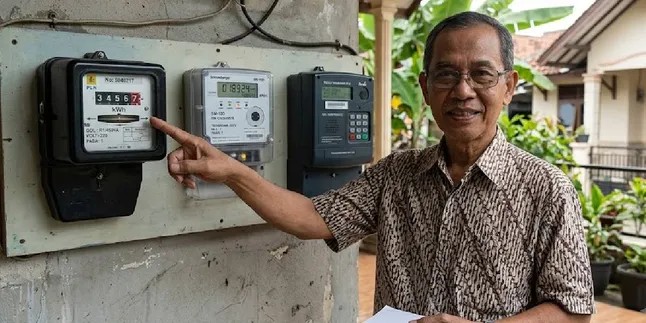
In addition to knowing the wattage, it is also important to understand the difference between watt and kilowatt-hour (kWh). Watt indicates the amount of power when the device is in use, while kWh represents the total energy consumed over a certain period. This unit is used in electricity bills.
Electricity consumption can be calculated using the following formula:
kWh = (Watt × Usage Time in Hours) ÷ 1,000
For example, a 60 watt fan used for 8 hours every day will consume about 0.48 kWh per day or about 14.4 kWh in a month.
If using an electricity rate of Rp1,444.70 per kWh, the cost of usage is only about Rp20,800 per month. This figure shows that fans are still much more economical compared to using air conditioning.
If you do not yet know the wattage of your fan, check the specification label on the motor housing or the instruction manual. If only the ampere value is listed, the wattage can be calculated by multiplying that number by the household voltage in Indonesia, which is about 220 volts.
By knowing how to calculate electricity consumption, you can more easily monitor energy usage at home and detect any unusual increases in consumption.
5. How to Save Electricity When Using a Fan
Choosing a fan with low power consumption does help reduce electricity usage, but daily usage habits also have a significant impact on the electricity bill. With the right habits, a fan can still provide comfort without consuming a lot of energy.
One thing to understand is that a fan works to provide a cooling sensation to people nearby, not to lower the room temperature. Therefore, leaving the fan on in an empty room will only waste electricity.
Here are some steps that can be applied to make fan usage more efficient.
- Use speed according to need
It is not always necessary to operate the fan at the highest speed. When the air temperature is not too hot, low or medium speed is sufficient to provide comfort while also reducing electricity consumption.
- Turn it off when the room is not in use
This simple habit is one of the most effective ways to save energy. If there are no people in the room, it is better to turn off the fan because the device does not cool the room directly.
A fan can also be used together with an AC. The airflow from the fan allows the AC temperature to be raised by about 4 degrees Fahrenheit without sacrificing comfort.
In fact, a study from University of California, Berkeley cited by Popular Science mentions that a person can still feel comfortable in a room that is 6 degrees warmer when a fan is used.
- Choose a fan with a DC motor or efficiency certification
DC motor models are generally more energy-efficient compared to conventional AC motors. Additionally, fans with energy efficiency labels are also worth considering.
According to Energy Star, certified ceiling fans can have efficiency up to 44 percent better than regular models thanks to more optimal motor and blade designs.
Dust accumulation on the blades and motor makes the device work harder. Regularly cleaning the fan helps maintain performance while also preserving electricity efficiency.
- Utilize the timer feature
If the fan is equipped with a timer, use this feature especially at night. The timer helps limit usage time so that electricity is not continuously consumed when the user has fallen asleep.
- Adjust the direction of the ceiling fan rotation
For ceiling fans, the direction of rotation also affects comfort. During hot weather, rotating counterclockwise helps push air down, making the room feel cooler.
In addition to considering usage methods, product quality is also an important factor. Fans with good motors are generally more durable, quieter, and capable of maintaining energy efficiency in the long term.
6. Knowing the Wattage of a Fan Helps Control Electricity Expenses
Knowing how many watts a fan uses is not only useful when choosing a product but also helps estimate monthly electricity consumption. Most household fans only require about 15–100 watts, much lower compared to air conditioning units.
The amount of electricity consumption is influenced by various factors, including the type of fan, size, motor technology, and usage methods. By understanding these characteristics, you can choose the appropriate device and use it more efficiently.
When calculating electricity costs, use a simple formula based on power (watts), duration of use, and electricity rates per kWh. This method makes it easier for you to estimate monthly expenses and compare the energy consumption of different types of fans.
For users still wondering if fans consume a lot of electricity, the answer is no. Compared to other cooling devices, fans remain an energy-efficient option as long as they are used according to needs and maintained regularly.
(kpl/mda)
Disclaimer: This translation from Bahasa Indonesia to English has been generated by Artificial Intelligence.


 Follow

 Rekomendasi