Kapanlagi.com - Friends of KLovers, the way to propagate pothos does not have to use complicated techniques or special tools. This ornamental plant, scientifically known as Epipremnum aureum, is actually one of the relatively easy plants to propagate from stem cuttings, and it can even start to grow roots when soaked in water.
Interestingly, a single lush pothos plant can be a source of many new seedlings as long as the cut part of the stem has a growing point or node. Royal Horticultural Society (RHS) also refers to epipremnum as a plant that is easy to propagate because its stems can produce roots from the leaf joints.
No wonder this plant is often chosen to beautify homes, shelves, and work areas without the need to buy new plants repeatedly. Here are ways to propagate pothos from various sources, Tuesday (18/8/2026).
1. Getting to Know Pothos Before Propagation
(Photo: Pexels)
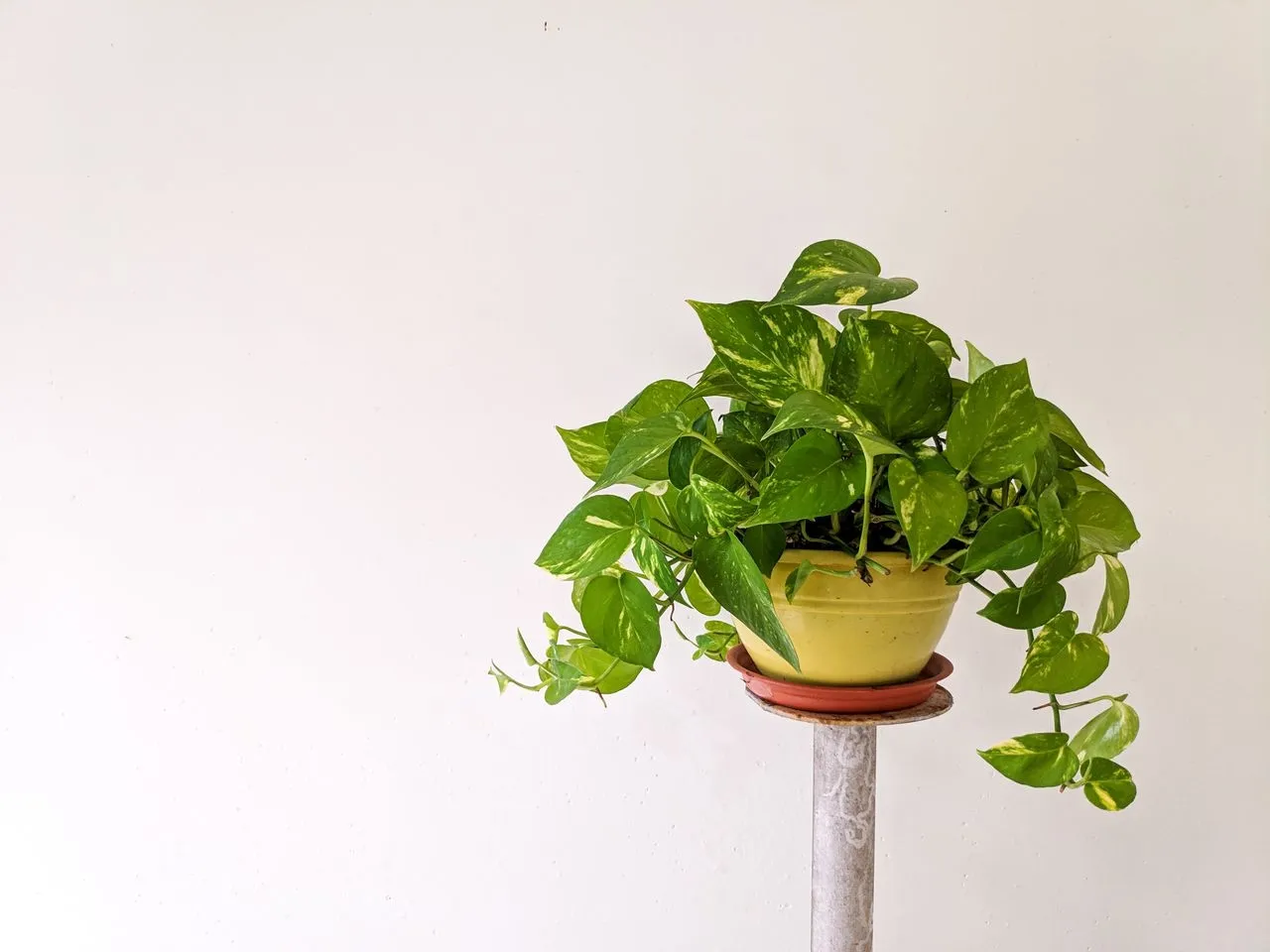
Pothos is a climbing plant from the Araceae family. Kew through Plants of the World Online records its scientific name as Epipremnum aureum (Linden & André) G.S.Bunting and notes that this plant originates from the Society Islands, particularly Moorea, and grows naturally in humid tropical environments.
In home care, pothos is known as a fairly adaptive plant. The Missouri Botanical Garden notes that this plant can grow in bright indirect light or partial shade, while the planting medium should maintain good drainage. This plant is also relatively easy to propagate through stem cuttings.
The most important thing to understand before propagation is the presence of the stem node. This part is where roots and new shoots emerge. Therefore, cutting one leaf without including a part of the stem that has a node is usually not sufficient to produce a new plant.
This is why the method of propagating pothos should not only focus on the length of the cuttings but also ensure that each cutting has at least one healthy node.
2. How to Propagate Golden Pothos in Water
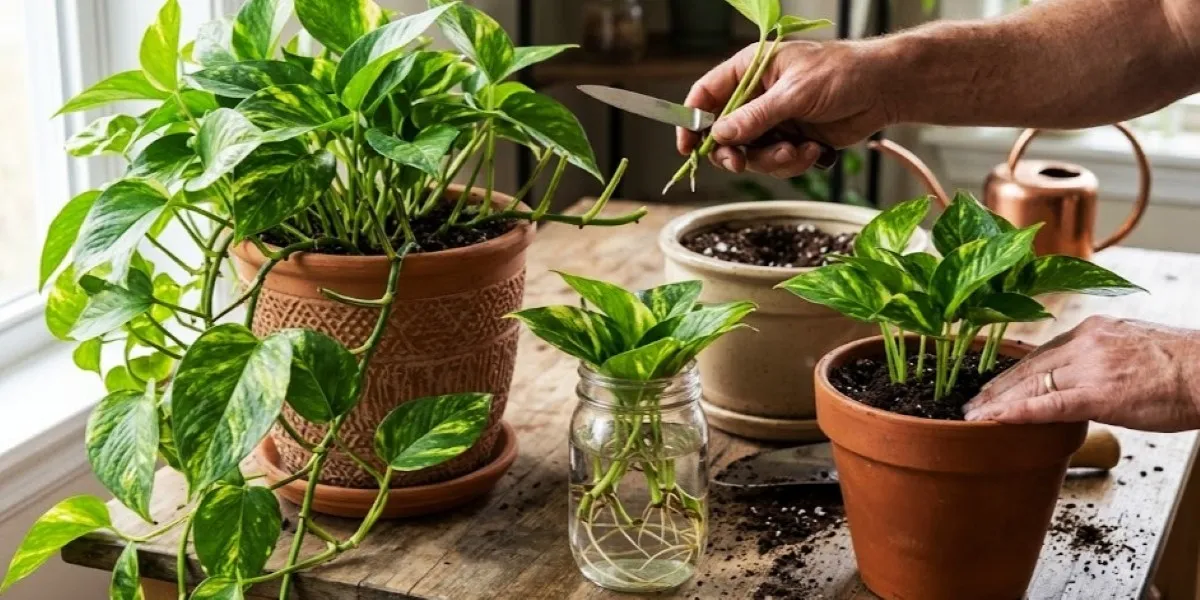
How to Propagate Golden Pothos in Water (AI Generated)
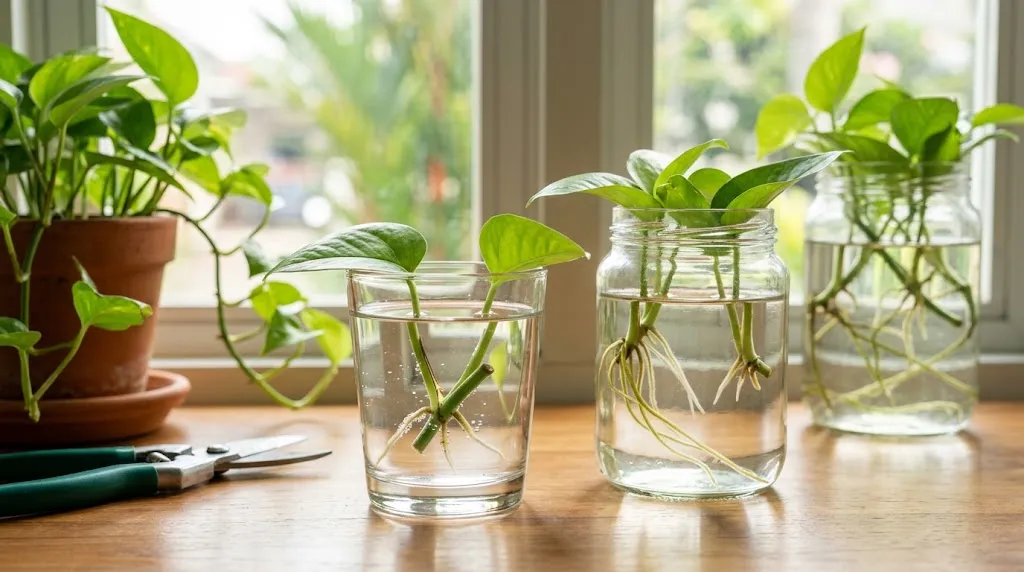
The water method is the simplest choice for beginners because root development can be observed directly. RHS recommends taking a stem cutting, cutting it just below the leaf joint, and then placing the cutting in a glass of water in a bright location until roots grow.
The process starts by selecting a healthy stem that is not soft and free from signs of rot. Use clean scissors or a knife to minimize the risk of contamination at the cut site.
Cut the stem into several pieces. Ensure that each cutting has at least one node and one or more leaves. If small aerial roots are present on the stem, that part can also serve as a point to aid the rooting process.
After that, place the node part into the water, while the leaves should remain above the water's surface. Position the container in an area that receives bright light but is not exposed to direct sunlight too strongly.
The water needs to be monitored to avoid becoming cloudy or smelly. When the roots start to develop and look healthy enough, the cutting can be transferred to a growing medium.
This method is interesting because root development can be monitored every day. However, do not rush to move the cutting just because a small root has appeared. The plant will be better prepared to adapt when its root system has developed well.
Propagating Pothos Directly in Growing Media
The method of propagating pothos can also be done directly using growing media. This technique is suitable for those who want to reduce the adaptation process from water conditions to soil.
Take a healthy stem, then cut it just below the node. Insert the node part into moist growing media that has good drainage. Do not plant too deeply because stems that are continuously in overly wet conditions are more susceptible to rot.
For the media, the main principle is not to use a specific material, but to ensure that the media can retain enough moisture while also allowing excess water to drain away.
A study by Attanayake and colleagues titled “Stimulatory Effect of Indole–3–Butyric Acid and Rooting Media on Adventitious Rooting in Epipremnum aureum ‘Marble Queen’ Stem Cuttings” published in 2023 in Indonesian Journal of Applied Research tested one-node cuttings of Epipremnum aureum ‘Marble Queen’. The study found that rooting media significantly affects the success of root formation, while a combination of media and certain concentrations of IBA can accelerate the rooting process.
This finding provides a simple lesson for plant owners at home: the condition of the media is as important as the quality of the stem used. Healthy cuttings can still fail if the media is too dense, too wet, or lacks sufficient air circulation.
3. Use the One Node Technique to Get More Cuttings
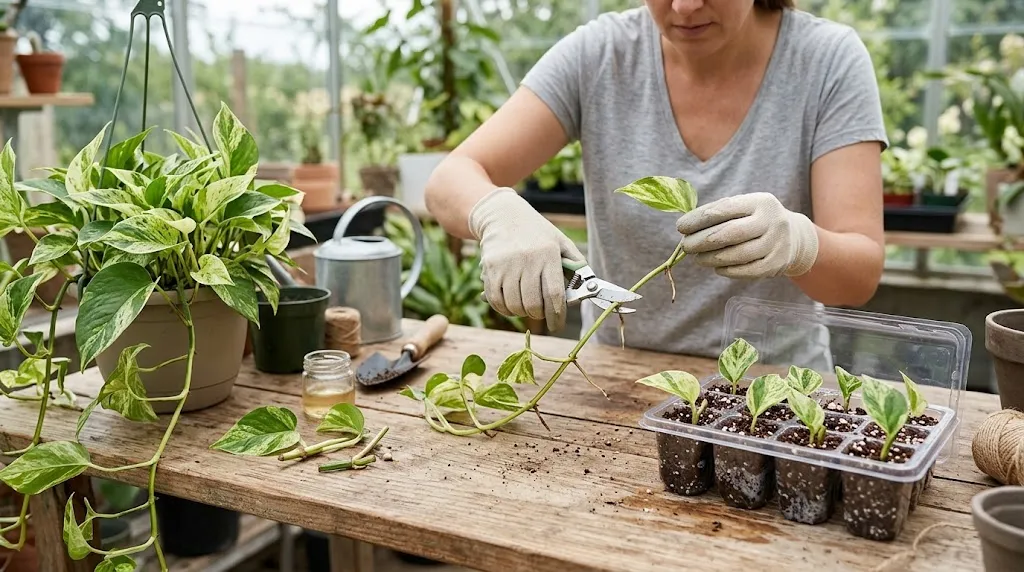
Use the One Node Technique to Get More Cuttings (AI Generated)
One of the ways to make the propagation process more efficient is the single-node cutting technique or one-node cutting. This technique is even used in the commercial propagation of Epipremnum aureum ‘Marble Queen’.
The principle is simple. A long stem does not need to be planted as one large piece. The stem can be divided into several parts, with each part having the necessary node to produce roots and new growth.
For example, one vine has several healthy nodes. Instead of planting the vine as one cutting, each node can be separated into several potential plants. In this way, one long parent plant has the potential to produce more seedlings.
However, the smaller the cuttings used, the more important it is to keep the environment stable. Make sure the medium is not too dry, but also not constantly waterlogged.
Try the Layering Technique Without Separating the Stem from the Parent
For beginners who are worried their cuttings will fail, the layering technique can be an option. RHS explains that the creeping epipremnum stem can be placed or held in the growing medium until roots begin to emerge from the leaf joint.
In this technique, the stem is not immediately cut from the parent plant. The node part is pressed lightly onto the moist medium, while the end of the stem remains connected to the main plant.
Once the node part produces sufficient roots, the stem can be cut from its parent and treated as a new plant. The advantage of this technique is that the cutting continues to receive support from the parent plant during the initial root formation phase.
This method is also suitable for plants with long tendrils. Instead of letting the stems hang down, several nodes can be directed into a new pot at once.
4. Choose the Right Stem, Not Just a Long Stem
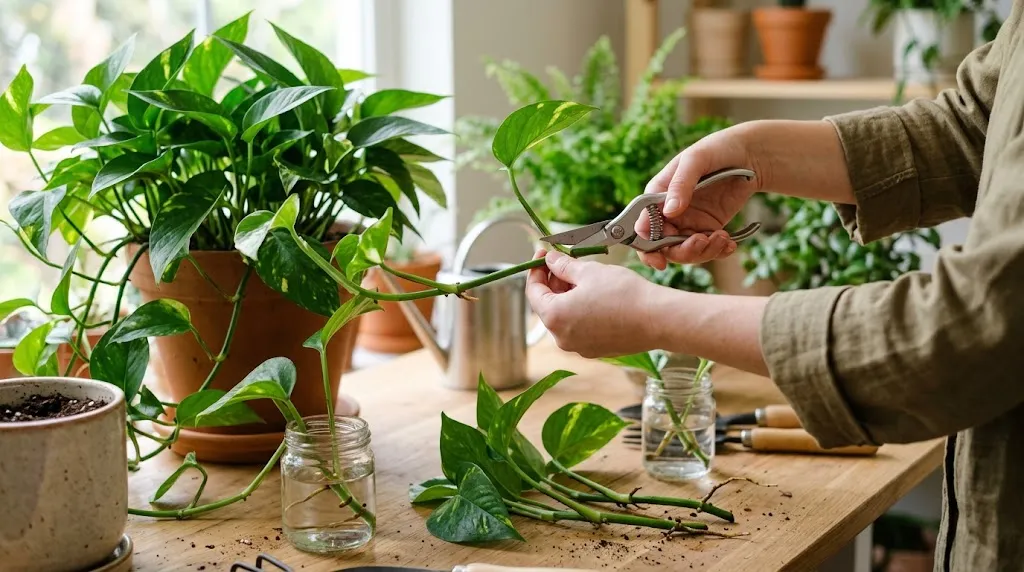
Choose the Right Stem, Not Just a Long Stem (AI Generated)
A common mistake in propagating golden pothos is selecting stems based solely on their size. In fact, a long stem is not necessarily the best cutting material.
Choose stems that appear healthy, have good leaves, show no signs of rot, and have clear nodes. Stems that are too weak or have already suffered damage will have a lower chance of developing optimally.
Pruning can also actually be part of routine care. RHS explains that pruning the stem tips can encourage the growth of side shoots, making the plant bushier. The resulting pruned stems can then be used as cutting material.
Thus, propagation should not be considered a task separate from care. Pruning done to tidy up the plant can simultaneously produce material for creating new plants.
Is Rooting Hormone Mandatory?
The answer is no. Golden pothos is indeed known to be easily propagated through stem cuttings, so rooting hormone is not an absolute requirement to start the process.
In the study “Root Organogenesis Induction in Epipremnum aureum Stem Cuttings with Plant Biostimulants and Synthetic Rooting Hormone” in 2022, Dadeth E. Villafuerte, Edwin Angeles, Angerica Bayog, Rhegine Duka, N.L.Meñoza, M.A.Sanchez, and R.De Jesus tested several treatments on E.aureum cuttings. The research showed that some treatments can affect root development, but the experiments were conducted under research conditions and do not mean that all houseplants must use rooting stimulants.
Therefore, beginners should prioritize the basics first: healthy stems, the right nodes, controlled moisture, well-draining media, and appropriate lighting.
Interestingly, other research also indicates that certain microorganisms have the potential to enhance root formation. In the study by Kaymak, Irmak, Aksoy, and Tekiner titled “AUXIN-PRODUCING PLANT GROWTH-PROMOTING RHIZOBACTERIA PROMOTE ROOT FORMATION OF EPIPREMNUM AUREUM CUTTINGS” published in 2021 in Journal of Animal and Plant Sciences, some bacterial treatments resulted in a higher rooting percentage compared to the control.
However, this fact is more relevant as scientific information regarding root physiology and does not yet need to be applied as a mandatory step in simple propagation at home.
5. Place in a Bright Spot, but Don't Scorch It
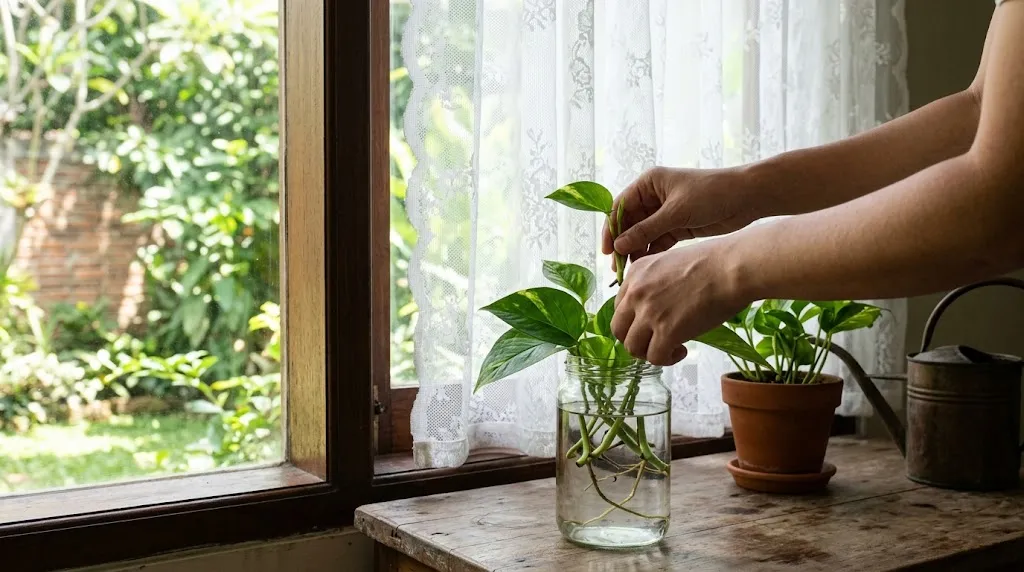
Place in a Bright Spot, but Don't Scorch It (AI Generated)
After the cutting is made, lighting becomes the next factor to consider. Devil's ivy can grow well in bright, indirect light, while too much direct sunlight can risk damaging the leaves.
A spot near a window with filtered light can be a good choice. If using the water method, do not place the glass directly under the scorching sun just to make the roots seem to grow faster.
Plants need balance. Light aids in the photosynthesis process, but an environment that is too hot and excessive evaporation can actually cause the cutting to lose moisture before its root system is established.
Avoid Mistakes That Cause Devil's Ivy Cuttings to Fail
In practice, propagation failures often occur not because the plants are difficult to grow, but because the conditions after cutting are not appropriate.
The first mistake is submerging the leaves in water. Leaves that are submerged are more likely to rot and can quickly degrade the quality of the water.
The second mistake is using media that is too wet. Moist media is different from media that is continuously waterlogged. Roots still need oxygen, so drainage is an important part of the rooting process.
The next mistake is taking cuttings without nodes. Leaves do indeed appear to be the main part of the plant, but for stem cutting techniques, the node is much more important because from that part, roots and new shoots can develop.
Also, do not pull out the cuttings too often to check if the roots have grown. Rooting takes time, and repeated disturbances can damage the young roots that are still vulnerable.
When Is the Pothos Cutting Ready to Be Transferred to a Pot?
There is no single number of days that applies to all conditions because the speed of rooting is influenced by variety, environment, cutting quality, media, water, temperature, and light.
For example, research by Villafuerte and colleagues monitored the root development of Epipremnum aureum cuttings for up to 30 days. This shows that the rooting process indeed occurs gradually and is not always instant.
For cuttings that are soaked in water, the easiest sign is the appearance of roots that have developed and look quite strong. After that, transfer them slowly to a medium with good drainage.
Do not immediately give a large amount of fertilizer to cuttings that are just adapting. In the early phase, the main focus is to help the plant build roots and adapt to its new environment.
6. How to Propagate Golden Pothos for a Denser Result
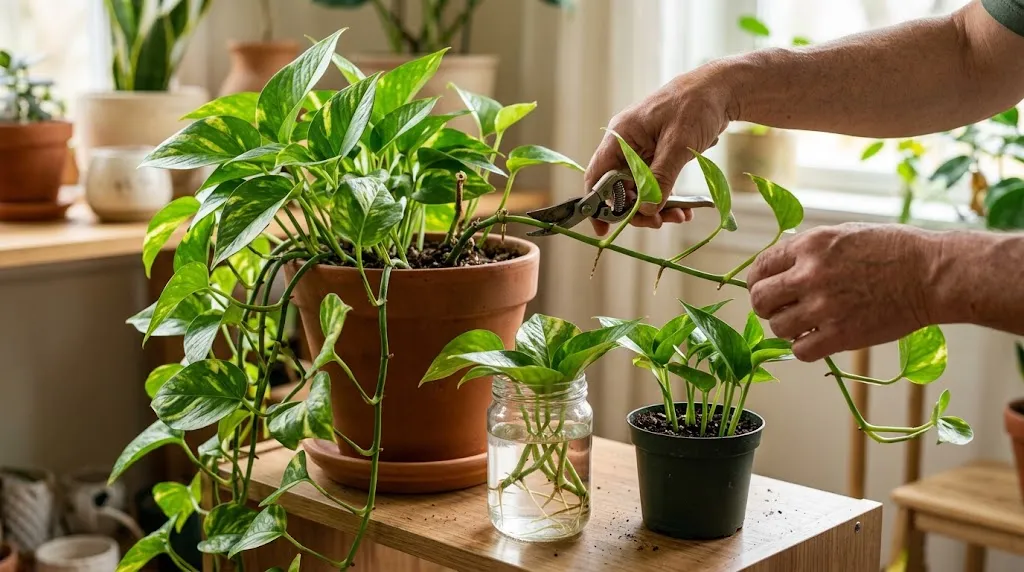
How to Propagate Golden Pothos for a Denser Result (AI Generated)
There is one strategy that is often overlooked. Increasing the number of plants is not just about making new cuttings, but also about how to keep the parent plant growing attractively.
After some stems are cut, the parent plant can stimulate the growth of new shoots from the remaining nodes. RHS states that pruning stems can encourage the emergence of side shoots, making the plant denser and preventing it from looking too long or thin.
Rooted cuttings can also be planted several pieces in one container. This method can produce a fuller appearance compared to just planting one cutting in one pot.
So, one parent plant can actually be utilized for two purposes at once: producing new cuttings and shaping the main plant to be bushier.
Tips for Successful Propagation of Pothos
The main key to propagating pothos is actually simple. Always ensure there is a node on each cutting, use clean cutting tools, maintain moisture without making the medium waterlogged, and provide bright indirect light.
For beginners, the water method is the easiest way because root development can be seen with the naked eye. Once accustomed, the direct planting technique or layering can be tried to produce a larger number of cuttings.
One thing that also needs to be considered is safety. RHS and the North Carolina Extension Gardener Plant Toolbox note Epipremnum aureum as a plant that can be dangerous if ingested and can cause irritation, so using gloves while pruning is a wise step, especially if there are children or pets at home.
Ultimately, the success of propagation is not determined by a special formula, but by selecting the right part of the plant and maintaining stable growing conditions. By understanding the function of nodes, the owner of the ivory vine can transform one long tendril into several potential new plants without a cumbersome process.
7. Questions and Answers About How to Propagate Golden Pothos
Can golden pothos be propagated only from leaves?
Generally no. For propagation through cuttings, the important part is the stem that has nodes or joints because from those points roots and new shoots can develop.
Is it better to propagate golden pothos in water or soil?
Both can be used. The water method is easier to monitor because the roots are visible directly, while cuttings placed directly in the planting medium can reduce the adaptation process from water to soil after the roots are formed.
How long does it take for golden pothos roots to appear?
The time can vary depending on the condition of the plant and the environment. Research on Epipremnum aureum has even monitored root development for up to 30 days, so it is best not to rush to assume that the cuttings have failed.
8.
(kpl/ibr)
Disclaimer: This translation from Bahasa Indonesia to English has been generated by Artificial Intelligence.


 Follow
 Rekomendasi