Kapanlagi.com - For those of you with limited yard space, how to plant baby kailan vegetables in a limited space can be a choice to produce fresh vegetables without needing a large garden. Kailan can be grown in polybags or pots and has a relatively short growth period, making it suitable for home gardens.
Kailan is known as Chinese kale or Chinese broccoli. Its leaves are thick, stems are crunchy, and the leaves, stems, and young flowers can be consumed. This plant is in the same family as broccoli and various other Brassica vegetables. The RHS explains that Chinese broccoli can be planted in containers of sufficient size to be harvested as baby leaves. For pot planting, the RHS recommends a container that is at least about 30 cm wide and deep. Meanwhile, the Yogyakarta City Agriculture and Food Office recommends a minimum size of 35 cm for polybags for kailan cultivation.
Planting baby kailan is also interesting because the plants can be harvested when they are still young. In fact, baby leaves can be picked when the plants are about 8–10 cm tall, while the Yogyakarta City Agriculture and Food Office states that kailan can start being harvested as baby kailan in about three weeks. However, do not plant them too densely. Kailan still needs light and air circulation to ensure its growth is not hindered, Thursday (20/8/2026).
1. Preparing the Place, Container, and Planting Media
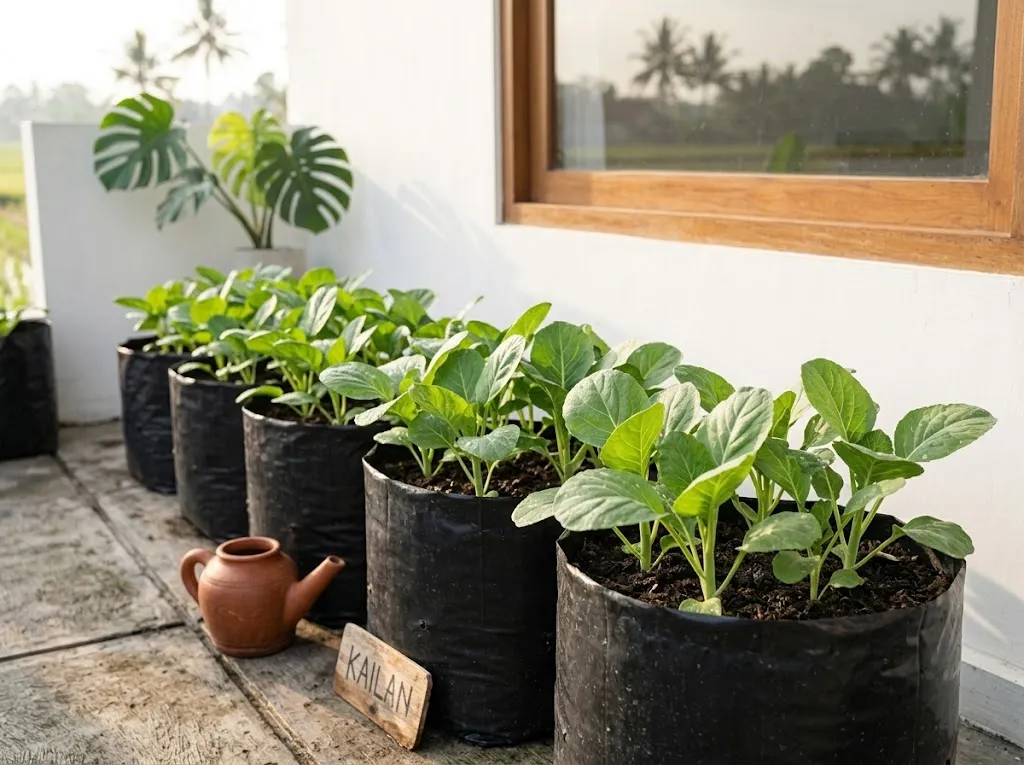
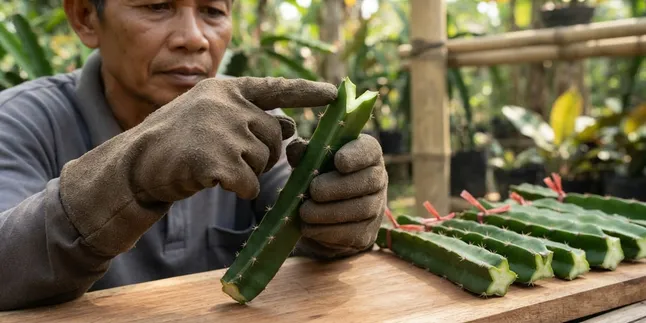
how to plant baby kailan vegetables in narrow land (AI generated)
1.Choose a Location that Receives Sufficient Light
The first step in how to plant baby kailan vegetables in narrow land is to determine the right location. Even when planted in polybags or pots, kailan still needs enough light for the leaves to grow healthy and not stretch out weakly. The Royal Horticultural Society (RHS) recommends that Chinese broccoli be planted in a spot that receives full sunlight, while the National Parks Board (NParks) guidelines state that kailan can grow well with about 4–5 hours of direct sunlight or more than six hours of indirect light.
In tropical homes, terraces, front yards, balconies, or areas near fences that receive morning sunlight can be utilized. Avoid locations that are completely shaded because the plants will struggle to get enough light. Conversely, if the spot receives direct sunlight all day and feels very hot, especially during the scorching afternoon, the plants may experience stress.
Before permanently determining the position of the pots, observe the area of the house for a few days. Choose a bright spot, but still allows the plants to get protection when the sun is too harsh or heavy rain falls.
2. Prepare Polybag or Pot
Polybags are a practical choice for small spaces because they are lightweight, relatively inexpensive, and easy to move. Choose containers that have adequate drainage holes so that excess water can escape and does not pool around the roots.
The Agriculture and Food Office of Yogyakarta City recommends a minimum polybag size of 35 cm for growing kailan. Meanwhile, RHS states that a container about 30 cm wide and deep can be used to grow Chinese broccoli as baby leaves.
For household needs, you do not have to provide many large pots. A few polybags arranged efficiently can already produce baby kailan for family consumption. Also, ensure that the bottom of the container is not covered with soil or surfaces that hinder water drainage, as poor drainage can make the medium too wet and increase the risk of root problems.
3. Create Fertile and Loose Planting Media
Planting media plays an important role in supporting the growth of kailan in containers. The Agriculture and Food Office of Yogyakarta City recommends a mixture of soil, rice husk, and manure in a ratio of 1:1:1, although the composition can be adjusted according to the available materials.
This mixture produces relatively fertile media that is also not too dense. Rice husk helps improve the structure of the media, while manure provides organic material and nutrients to support plant growth.
RHS also emphasizes that Chinese broccoli requires media rich in organic material, capable of retaining moisture, but still has good drainage. This condition is important because kailan prefers media that is consistently moist, but does not do well in conditions where the roots are continuously submerged.
Before use, mix all materials evenly. Avoid using raw manure as it can disrupt the growth of young plant roots.
2. Sowing and Planting Kailan Seeds
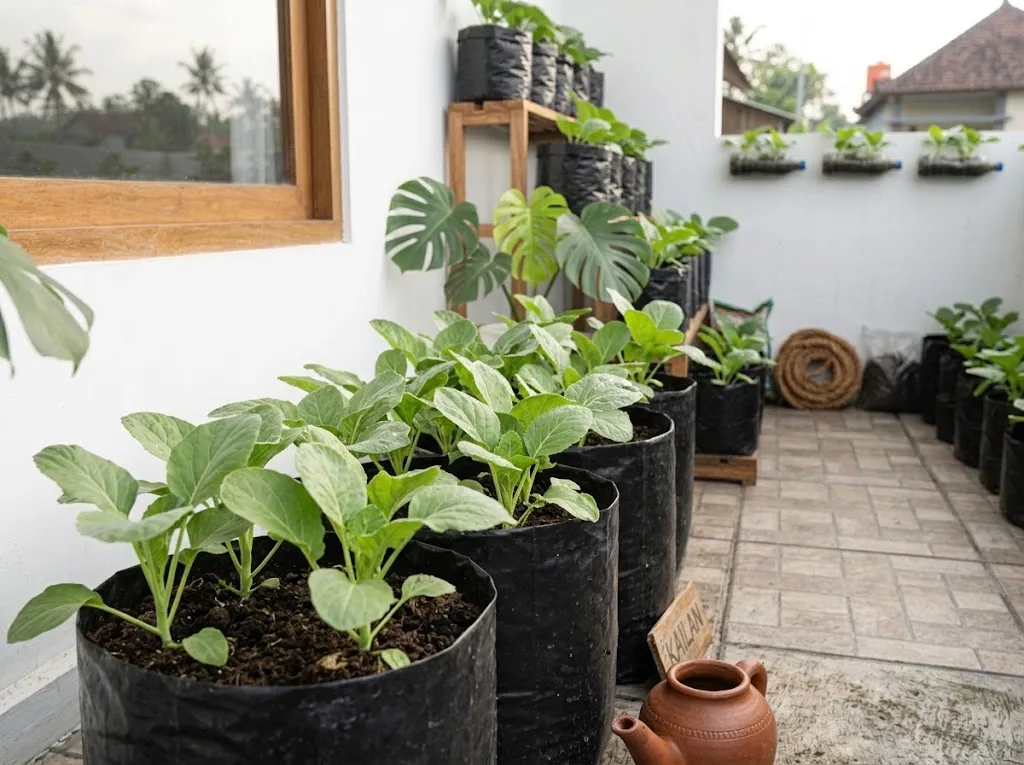
how to plant baby kailan vegetables in narrow land (AI generated)
4.Seedling Kailan
Baby kailan can be cultivated from seeds. For beginners, pre-sowing using a seed tray can facilitate monitoring during the early growth phase. Use fine seedling media with good drainage.
Create small holes, insert the seeds, then cover lightly with media. After that, water using a fine spray to ensure the seeds do not shift or become buried too deep. Keep the media moist without making it waterlogged.
According to NParks guidelines, kailan seeds can germinate in about a week if the media conditions are appropriate. Young seedlings should be placed in an area protected from heavy rain and excessive heat.
At this stage, also pay attention to the presence of snails, slugs, and birds that can damage the seedlings. Fine nets or simple covers can be used to provide additional protection.
5. Transplant Strong Seedlings
Seedlings should not be transplanted when they are still too small. Wait until the plants have several true leaves and the roots are starting to develop well.
NParks states that seedlings can be transplanted when they have at least four leaves or about one to two weeks after germination. Meanwhile, the Agriculture and Food Office of Yogyakarta City uses healthy seedlings that are about three to four weeks old for planting.
The difference in timing indicates that the readiness of seedlings is not solely determined by age. The physical condition of the plants, the number of leaves, the strength of the stems, and the development of the roots also need to be considered.
When transplanting seedlings, try to keep some of the media attached to the roots so that the roots are not too disturbed. Planting should preferably be done in the morning or late afternoon to prevent the seedlings from facing strong sunlight immediately.
6. Arrange Planting Distances to Avoid Crowding
Limited land indeed makes us want to plant kailan as close as possible. However, plants that are too close together may lack space, light, and air circulation.
For plants intended as baby leaves, RHS recommends a spacing of about 10–15 cm. NParks also mentions a spacing of about 10–20 cm between plants to aid growth.
This spacing can be applied when several plants are grown in one large container. For baby kailan, relatively close planting is still feasible because the plants will be harvested while they are young. However, make sure that the leaves do not completely overlap, as overly dense conditions can hinder growth and air circulation.
7. Utilize Shelves to Save Space
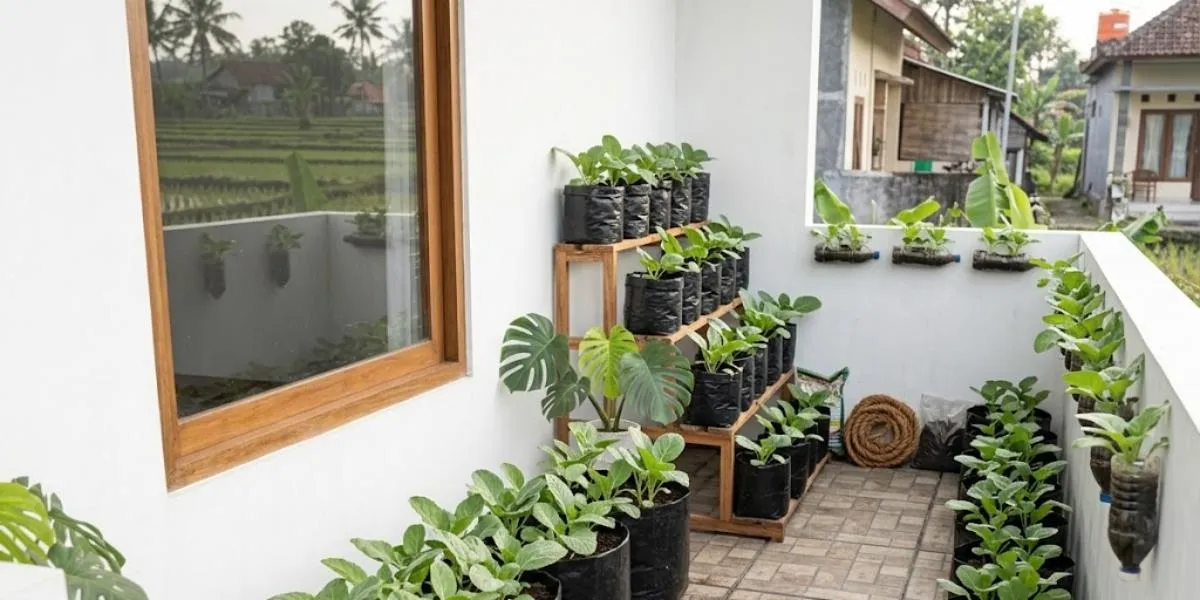
If the yard is very limited, tiered shelves can be a solution to increase the number of plants without expanding the planting area horizontally. Polybags can be arranged on several levels as long as the shelf is sturdy enough to support the weight of the media and water.
Pay attention to light distribution when using shelves. Plants at the lower level should not be completely blocked by the plants or containers above them. Every plant still needs sufficient light.
Make sure the rack is placed in a safe area and is not easily exposed to strong winds. Another alternative is to use elongated pots placed along the fence or side of the terrace.
With neat arrangement, a narrow space does not have to look full and messy. Plant containers can even become part of the home's greenery while providing fresh vegetables.
3. Caring for Baby Kailan for Fast and Healthy Growth
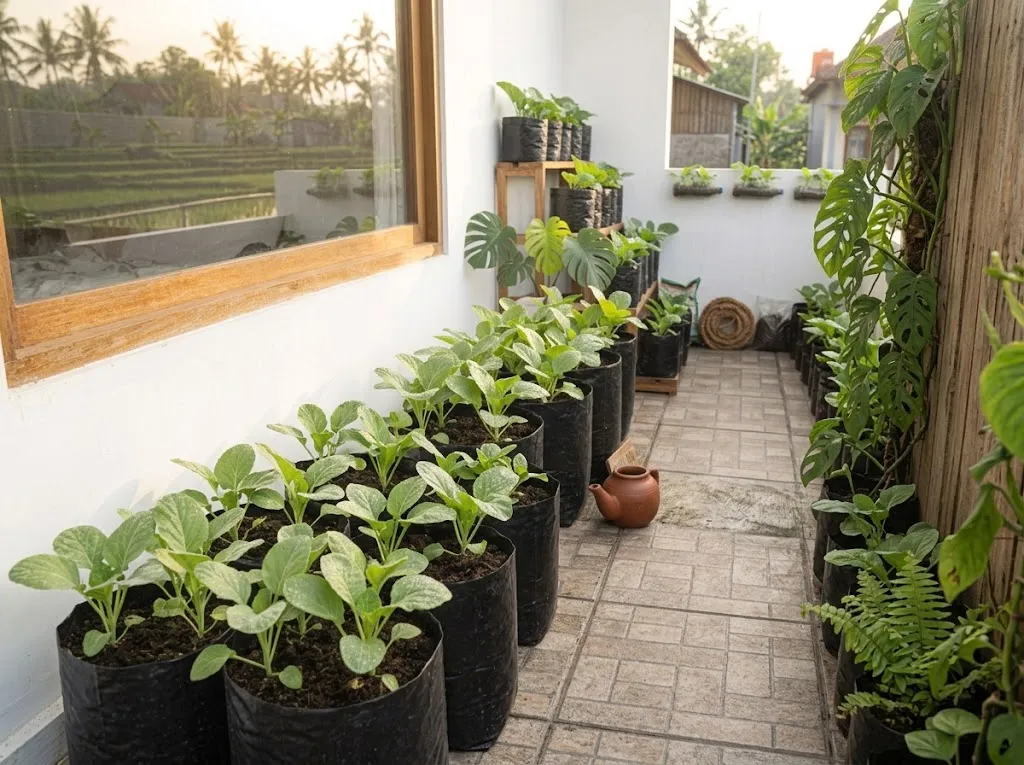
how to plant baby kailan vegetables in narrow land (AI generated)
8. Water Regularly, but Don't Overdo It
Chinese broccoli likes moist media, but that doesn't mean the media should always be wet or flooded. Plants grown in pots require more attention because the media in containers can dry out faster than soil in the garden.
The RHS recommends regular watering for young plants, especially during dry conditions. Watering should be done in the morning so that the plants have enough water to support growth throughout the day.
When the weather is hot, check the condition of the media using your finger. If the surface starts to feel dry, water it enough until the media becomes moist again. Avoid overwatering because Chinese broccoli can experience root problems if drainage is not functioning well.
9. Provide Nutrients Regularly
Chinese broccoli is a relatively fast-growing plant, so it requires adequate nutrients to form leaves and stems. The Agriculture and Food Service of Yogyakarta City recommends fertilization to begin about two weeks after transplanting. Manure can be used periodically, while NPK compound fertilizer with a higher nitrogen content can also be an option.
NParks explains that kailan, which grows quickly, can produce more leaves if it receives sufficient nitrogen nutrients. Fertilization can be done periodically after the plants are transferred to the growing container.
However, fertilizer application should not be excessive. Young plants do not require as much nutrition as fully developed plants. If using commercial fertilizer, follow the dosage indicated on the packaging.
10. Protect from Caterpillars, Aphids, and Snails
As a member of the Brassica family, kailan can face a number of pests. The Agriculture and Food Service of Yogyakarta City mentions caterpillars, insects, aphids, and beetles as some of the pests that can attack kailan plants. The management is recommended to use the principles of Integrated Pest Management (IPM) and to use chemicals as minimally as possible.
NParks also notes that young seedlings can be eaten by snails and slugs, while caterpillars can cause holes in the leaves. In narrow areas, manual plant inspections are quite easy to perform since the number of plants is usually not too many.
Regularly check the underside of the leaves. If you find caterpillars, eggs, or leaves that are heavily damaged, remove them manually immediately. Protective nets can also be used to reduce the likelihood of pests reaching the plants.
11.Use Mulch on the Surface of the Media
Mulch can be used as a supplement to the care of baby kailan planted in polybags. Suitable organic materials can be placed thinly on the surface of the media to help retain moisture.
According to RHS, organic mulch can help retain water in the media while also reducing weed growth. This is quite useful for container plants that lose moisture more quickly during hot weather.
However, do not make the mulch layer too thick, especially on small-sized polybags. Provide space around the base of the stem to ensure good air circulation and prevent the stem from continuously touching overly damp materials.
4. Harvesting and Managing Planting Cycles
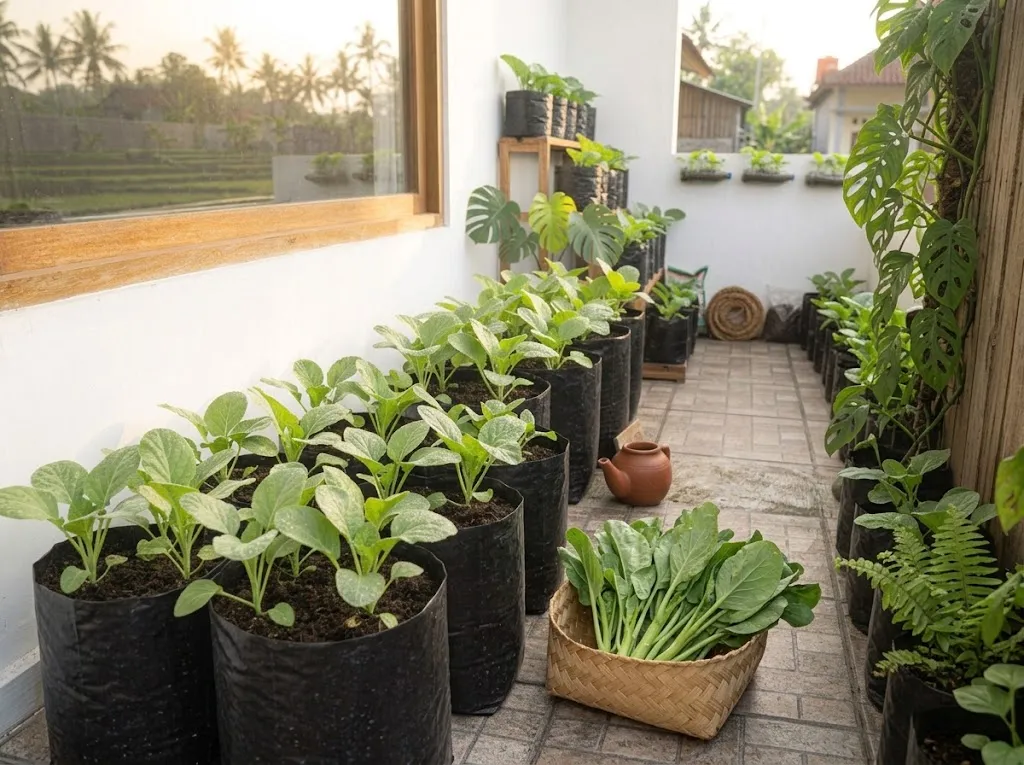
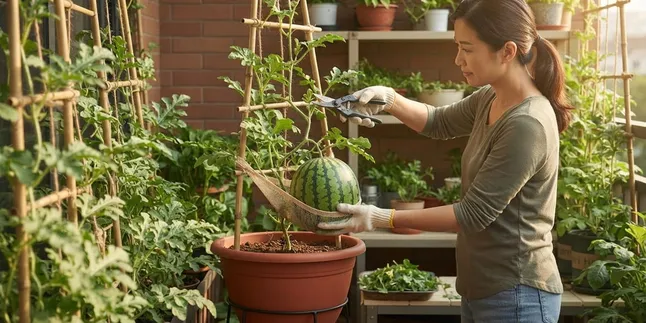
how to plant baby kailan vegetables in narrow land (AI generated)
12.Harvest Baby Kailan When It's Young
The most interesting part of growing baby kailan in narrow spaces is its relatively quick harvest time. You don't have to wait for the plants to grow large because the young leaves can already be consumed.
The Agriculture and Food Office of Yogyakarta City states that kailan can be harvested starting from around three weeks for the baby kailan category. RHS also explains that the young leaves of Chinese broccoli can be harvested in about three weeks, especially when the plants have reached a height of about 8–10 cm.
To obtain tender baby leaves, choose leaves that are still young. Use clean scissors or a knife when cutting to avoid unnecessary damage to the plants.
Kailan can also be harvested gradually. Instead of uprooting the entire plant, some outer leaves can be picked first so that the center of the plant still has a chance to produce new leaves.
13.Implement Staggered Planting for Continuous Harvest
Narrow land can actually be utilized more efficiently through a staggered planting pattern. You do not need to sow all the seeds at once because this will cause all the plants to enter the harvest period at the same time.
For example, sow the first group in the first week. One or two weeks later, sow again with a smaller amount of seeds. Repeat this pattern according to the family's consumption needs.
RHS also recommends sowing in small groups periodically to achieve more sustainable harvests. With this system, some plants can be harvested while the next group is still in the growth stage.
In addition to making vegetable supplies more regular, staggered planting patterns also help save space. The number of polybags can be adjusted to needs so that a small yard remains organized and not filled with plants all at once.
Errors to Avoid
There are several simple mistakes that often prevent baby kailan from growing optimally. First, choosing a location that is too dark. Lack of light can cause plants to grow elongated, thin, and have smaller leaves.
Second, using media that is too dense or lacks drainage. Kailan needs moisture, but the roots still require air and should not be continuously submerged.
Third, planting too closely without considering air circulation. Fourth, neglecting pests from the seedling phase. Because kailan is still young when harvested as a baby vegetable, early leaf damage can significantly affect the quality of the yield.
Finally, do not wait for the plants to get too old if the target is baby kailan. Young harvesting is actually the main advantage of this plant. Young leaves and stems tend to be softer, making them suitable for stir-frying, steaming, or processing into various dishes.
5. Q&A About Planting Baby Kailan
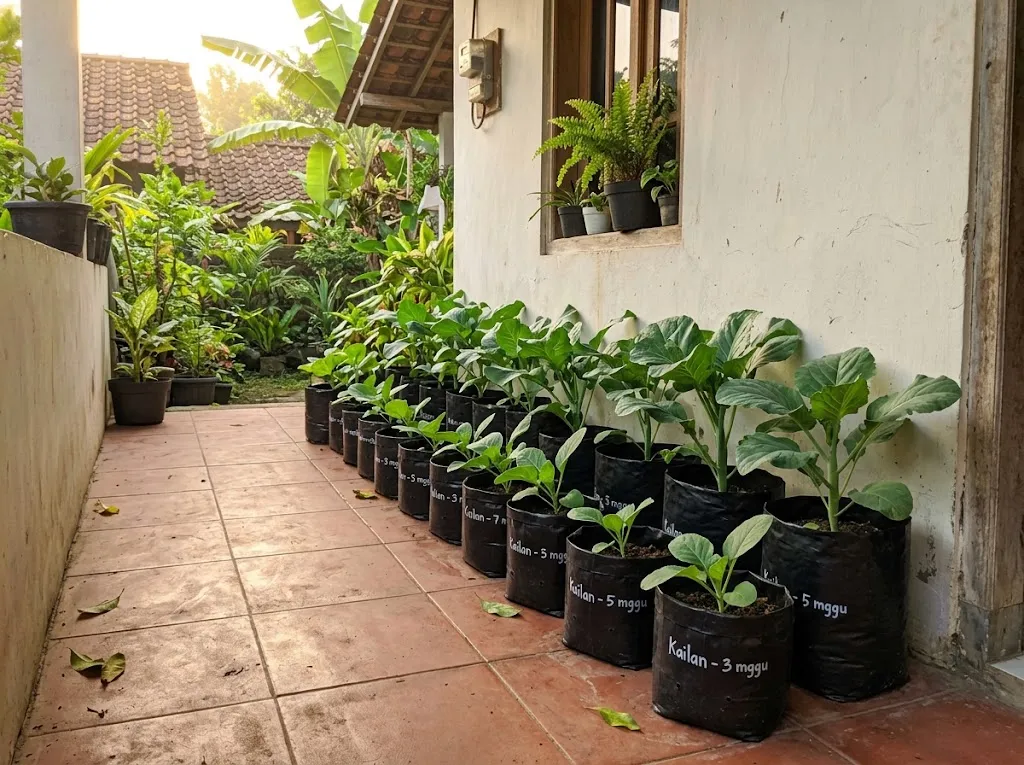
how to plant baby kailan vegetables in narrow land (AI generated)
1. How long can baby kailan be harvested?
Baby kailan can start to be harvested around three weeks under good growing conditions. RHS states that young leaves can be harvested when the plants are about 8–10 cm, while the harvest time is greatly influenced by the variety and environmental conditions.
2. Can baby kailan be grown in polybags?
Yes. Kailan can be grown in polybags or other containers. The Agriculture and Food Service of Yogyakarta City recommends polybags of at least about 35 cm, while RHS suggests containers about 30 cm wide and deep for planting Chinese broccoli as baby leaves.
3. What is the planting distance for baby kailan?
For harvesting as baby leaves, a distance of about 10–15 cm can be used. The distance provides enough space for leaf growth without requiring an area as large as the planting of kailan until full size.
4. Does kailan need direct sunlight?
Kailan requires sufficient light. Locations with morning sunlight are very good, but in very hot conditions, the plants need to be protected from excessive exposure. NParks guidelines mention a need for about 4–5 hours of direct sunlight or more than six hours of indirect light.
5. How can baby kailan be protected from being eaten by caterpillars and snails?
Check the plants regularly, especially the undersides of the leaves. Caterpillars can be removed manually, while protective nets can help prevent pests from reaching the plants. Young seedlings should also be protected as they are more vulnerable to snails and slugs.
References
- Yogyakarta City Agriculture and Food Service, “Cultivation of Kailan in Polybags”, November 8, 2021. Yogyakarta City Agriculture and Food Office Website
- Royal Horticultural Society (RHS), “How to Grow Chinese Broccoli”. RHS guide on Chinese Broccoli
- National Parks Board Singapore (NParks), “Kai Lan”, Gardening Resource Library. NParks guide on Kai Lan
(kpl/yni)
Disclaimer: This translation from Bahasa Indonesia to English has been generated by Artificial Intelligence.


 Follow
 Rekomendasi